Running bamboo (Phyllostachys species) sends out long underground rhizomes that travel several metres from the parent plant in a single growing season — this is the invasive type that causes property disputes and structural damage. Clumping bamboo (Bambusa species) stays in a tight cluster and is much easier to manage. If you’ve got a bamboo problem that brought you to this page, it’s almost certainly the running type.
The fundamental difference — how they grow
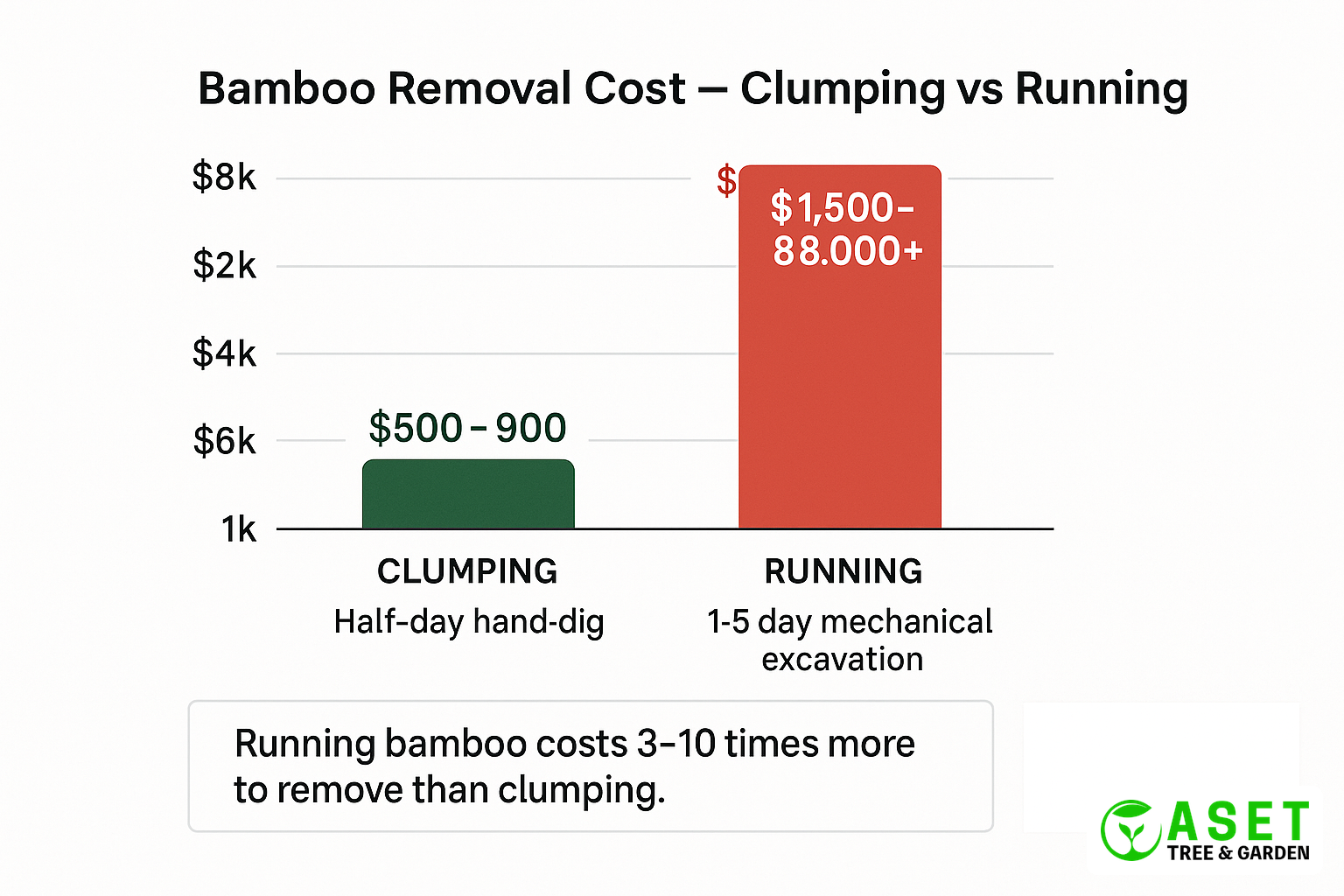
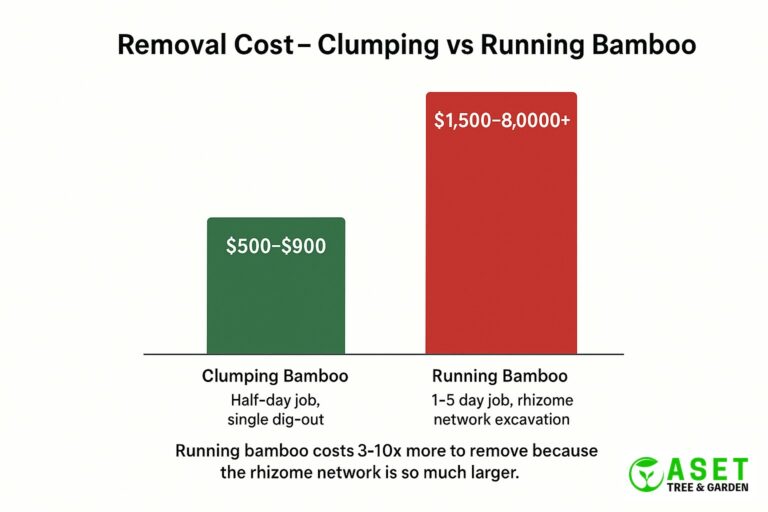
Running bamboo costs 3-10x more to remove.
Cost difference at a glance
$500
Clumping low end
small, soft soil, half-day
$900
Clumping typical
medium clump, one operator
$1,500
Running low end
small stand, sandy soil
$8,000+
Running large
mature stand + root barrier
Running bamboo: leptomorphic rhizomes that spread laterally, sometimes metres per growing season. Clumping bamboo: pachymorphic rhizomes that stay tight to the parent, expanding the cluster by only a few centimetres per year. Every other contrast — spread pattern, removal cost, chance of crossing onto a neighbour’s property, chance of structural damage — flows directly from this single biological difference.
How to identify which one you have
Where the cost gap comes from
Cost factor
Clumping
Running
Excavation method
Hand-dig (mattock + spade)
Mini excavator + hand-finish
Time on site
Half day — 1 operator
1-5 days — 2-3 operators
Rhizome network size
Tight ball — under 600mm wide
Sprawling — 5-10m horizontally
Follow-up needed
Usually none
6-week check + chemical spot-treat included
Barrier install
Not needed
Often required on boundary (+$1.5-3k)
Disposal volume
1-2 trailer loads
5-15 trailer loads
Typical cost range
$500-$900
$1,500-$8,000+
Look at the new-shoot pattern: scattered (running) vs clustered (clumping). Distance between new shoots and the original clump: metres (running) vs centimetres (clumping). Rhizome appearance when exposed: long thin segmented stems (running) vs short knobbly clusters (clumping). Common species names: Golden Bamboo, Black Bamboo, Moso (running) vs Slender Weaver, Goldstripe, Buddha Belly (clumping).
What Our Sydney Customers Say
Their service was fantastic from the first call to finishing the job. I needed 3 palm trees removed from my yard in Narellan Vale. I called and the customer service was very quick, polite, professional and helpful. I got the quote which was much cheaper than quoted elsewhere. They were able to come the next morning and did a great job removing the rubbish and tidying up. Highly recommend!
read moreread less
naomi gauld
1/23/2026
×
naomi gauld
1/23/2026
Their service was fantastic from the first call to finishing the job. I needed 3 palm trees removed from my yard in Narellan Vale. I called and the customer service was very quick, polite, professional and helpful. I got the quote which was much cheaper than quoted elsewhere. They were able to come the next morning and did a great job removing the rubbish and tidying up. Highly recommend!
Quick response with a quote.. Very friendly and Great work ethic and reasonable pricing. Highly recommend… Appreciate your help cleaning up our Backyard Garden and taking it away for us as well. Regards George
read moreread less
George Apostal
4/03/2024
×
George Apostal
4/03/2024
Quick response with a quote.. Very friendly and Great work ethic and reasonable pricing. Highly recommend… Appreciate your help cleaning up our Backyard Garden and taking it away for us as well. Regards George
Excellent service. Amy and the team were wonderful to deal with right from the first call. The team provided us with a range of potential solutions based on our situation and ended up recommending us one which was the least costly. Along the way the communication from Amy was always clear. She always made time for us and answered any questions we had before we made any decisions. Highly recommend and would be happy to utilise them again for any future needs.
read moreread less
K L
12/23/2025
×
K L
12/23/2025
Excellent service. Amy and the team were wonderful to deal with right from the first call. The team provided us with a range of potential solutions based on our situation and ended up recommending us one which was the least costly. Along the way the communication from Amy was always clear. She always made time for us and answered any questions we had before we made any decisions. Highly recommend and would be happy to utilise them again for any future needs.
The team at ASET were great. Job was to remove 5 very large hedges. Very helpful while organising the quote and explained everything, very accommodating in scheduling, and were able to fit me in earlier than initially expected. Great communication throughout the whole process. The guys did a great job, very quick and efficient, and cleaned up after the job. Would definitely recommend or hire them again.
read moreread less
Courtnee Barnes
4/21/2024
×
Courtnee Barnes
4/21/2024
The team at ASET were great. Job was to remove 5 very large hedges. Very helpful while organising the quote and explained everything, very accommodating in scheduling, and were able to fit me in earlier than initially expected. Great communication throughout the whole process. The guys did a great job, very quick and efficient, and cleaned up after the job. Would definitely recommend or hire them again.
Very happy with the work done by Amy, Ahmads and their crew. They did a very thorough and clean, neat job on my garden as it required lots of manual weeding, spraying, whipper snipping etc due to having lots of pebbles, pavers, rocks etc. Very reasonably priced based on the long hours they put in and I would definitely call them back again for my next garden maintenance job.
read moreread less
veronica loh
10/07/2025
×
veronica loh
10/07/2025
Very happy with the work done by Amy, Ahmads and their crew. They did a very thorough and clean, neat job on my garden as it required lots of manual weeding, spraying, whipper snipping etc due to having lots of pebbles, pavers, rocks etc. Very reasonably priced based on the long hours they put in and I would definitely call them back again for my next garden maintenance job.
ASET Tree Removal & Garden Rejuvenation did an amazing job of our whole complex’s multiple gardens. The whole team were friendly and professional, and Amy and Ahmed could not have been more accommodating. They communicated every step of the process and were happy to work with us to achieve a fantastic result that has lasted for months based on their recommendations. From quote to job completion, they were fantastic.
read moreread less
Lisa Santos
11/01/2024
×
Lisa Santos
11/01/2024
ASET Tree Removal & Garden Rejuvenation did an amazing job of our whole complex’s multiple gardens. The whole team were friendly and professional, and Amy and Ahmed could not have been more accommodating. They communicated every step of the process and were happy to work with us to achieve a fantastic result that has lasted for months based on their recommendations. From quote to job completion, they were fantastic.
They did an amazing job cleaning and organising my yard. They were really friendly, gave great advice and were fair priced. Thanks dor and awesome job. Highly recommend ASET Tree Removal.
read moreread less
Angelo Iannarilli
10/12/2024
×
Angelo Iannarilli
10/12/2024
They did an amazing job cleaning and organising my yard. They were really friendly, gave great advice and were fair priced. Thanks dor and awesome job. Highly recommend ASET Tree Removal.
The team were responsive and professional. Their quality of work was exceptional, thorough and suggestions were made while the original scope was being carried out that was extremely helpful. A detailed quote and scope of work was provided prior to commencement of the job.
read moreread less
Christina
12/23/2024
×
Christina
12/23/2024
The team were responsive and professional. Their quality of work was exceptional, thorough and suggestions were made while the original scope was being carried out that was extremely helpful. A detailed quote and scope of work was provided prior to commencement of the job.
I needed a yucca tree removed at my property in Pendle Hill and I am so glad I called ASET Tree Removal. From the very start, the experience was seamless. I was dealing with Amy and her team, who were incredibly professional, polite, and easy to communicate with. They made the entire process stress-free and provided a fair quote. The team did a fantastic job with the yucca removal including cleaning up perfectly. If you are looking for a reliable, hardworking, and friendly team for tree services, I cannot recommend ASET Tree Removal enough.
read moreread less
Joanne
12/18/2025
×
Joanne
12/18/2025
I needed a yucca tree removed at my property in Pendle Hill and I am so glad I called ASET Tree Removal. From the very start, the experience was seamless. I was dealing with Amy and her team, who were incredibly professional, polite, and easy to communicate with. They made the entire process stress-free and provided a fair quote. The team did a fantastic job with the yucca removal including cleaning up perfectly. If you are looking for a reliable, hardworking, and friendly team for tree services, I cannot recommend ASET Tree Removal enough.
Quoted for 100 metre's of hedging and removal of vegetation that had over grown onto a busy pedestrian footpath. The team at ASET were great, very professional, accommodating and friendly. Cleaned the site to perfection, did more then i expected, which was pleasant to see. Would highly recommend the ASET team and will definitely hire again for the next project.
read moreread less
Jake Trivor
8/05/2024
×
Jake Trivor
8/05/2024
Quoted for 100 metre's of hedging and removal of vegetation that had over grown onto a busy pedestrian footpath. The team at ASET were great, very professional, accommodating and friendly. Cleaned the site to perfection, did more then i expected, which was pleasant to see. Would highly recommend the ASET team and will definitely hire again for the next project.
Ahmad was very professional during quote and conduct of the job. He engaged with me at all stages to ensure the work was carried to out my requirements. Highly recommended.
read moreread less
Simon Harris
10/07/2025
×
Simon Harris
10/07/2025
Ahmad was very professional during quote and conduct of the job. He engaged with me at all stages to ensure the work was carried to out my requirements. Highly recommended.
Want to know what YOUR bamboo will actually cost?
Generic price ranges are useless — your bamboo type, soil, access, and stand size all matter. We give you a written quote with line items, not a vague estimate.
Why running bamboo is the problem species in Sydney
“I needed a yucca tree removed at my property in Pendle Hill and I am so glad I called ASET Tree Removal. From the very start, the experience was seamless. I was dealing with Amy and her team, who were incredibly professional, polite, and easy to communicate with.”
— Joanne, Pendle Hill · ★★★★★
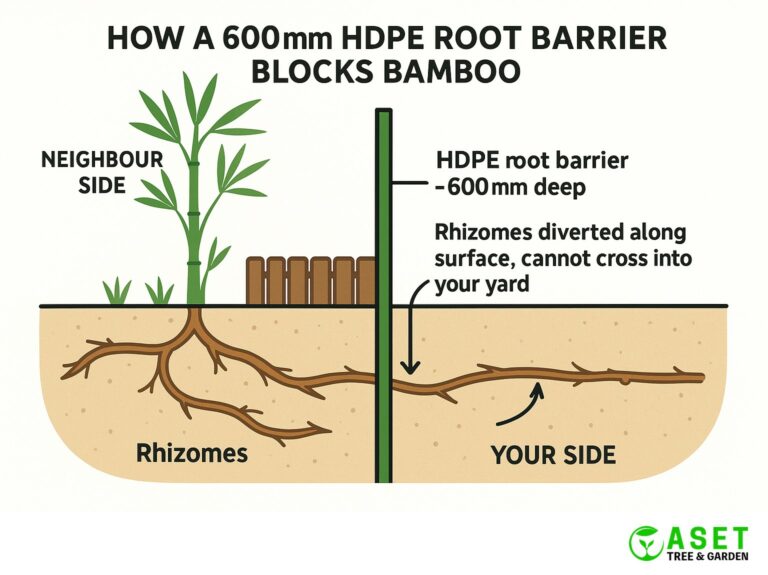
Spreads underground without warning. Crosses property lines invisibly until shoots emerge on the other side. Damages paving, pool surrounds, and foundations as rhizomes follow the path of least resistance. Hard to contain without a properly installed root barrier. The vast majority of neighbour-bamboo calls involve running bamboo.
Why clumping bamboo is usually manageable
Why running costs 3-10x more
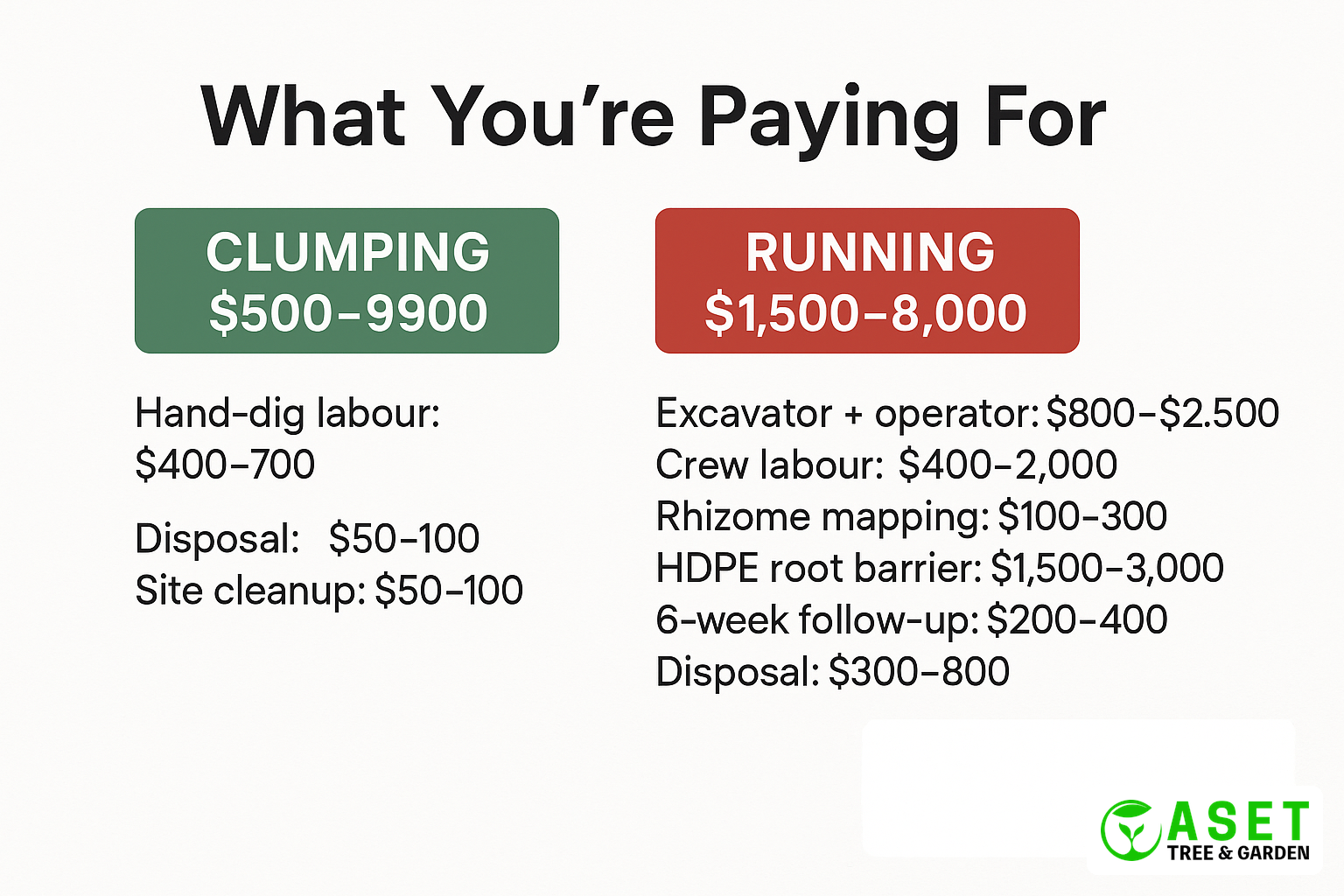
✓ What you’re paying for with running
Mechanical excavation (excavator + operator hire)
Rhizome mapping — we probe before we dig
Multi-day labour on site
6-week follow-up visit included
Often a root barrier on the boundary side
Large disposal volume
✗ What clumping skips
No mechanical excavation — hand tools only
No rhizome mapping needed — root ball is visible
Half-day job, single operator
No follow-up — one visit and done
No barrier — bamboo doesn’t spread
Small disposal volume
Predictable spread (millimetres per year, not metres). Stays where it’s planted. Can be enjoyed as a screening plant without aggressive containment. Easier and cheaper to remove if you change your mind. Still benefits from a root barrier as a planting precaution.
Common bamboo species in Sydney gardens
Running: Golden Bamboo (Phyllostachys aurea) — extremely common, extremely invasive. Black Bamboo (Phyllostachys nigra) — popular ornamental, invasive. Moso (Phyllostachys edulis) — tall, very fast spread.
Refer to the NSW DPI WeedWise listing for official invasive classifications.
What Our Sydney Customers Say
Excellent service. Amy and the team were wonderful to deal with right from the first call. The team provided us with a range of potential solutions based on our situation and ended up recommending us one which was the least costly. Along the way the communication from Amy was always clear. She always made time for us and answered any questions we had before we made any decisions. Highly recommend and would be happy to utilise them again for any future needs.
read moreread less
K L
12/23/2025
×
K L
12/23/2025
Excellent service. Amy and the team were wonderful to deal with right from the first call. The team provided us with a range of potential solutions based on our situation and ended up recommending us one which was the least costly. Along the way the communication from Amy was always clear. She always made time for us and answered any questions we had before we made any decisions. Highly recommend and would be happy to utilise them again for any future needs.
Great team who does fantastic work. Came out to inspect, talked me through the work, kept me well informed during booking, before arriving and on the job. Very knowledgeable and professional. Job well done and easy recommendation. Will be retaining their services for ongoing work.
read moreread less
Kevin Tam
10/30/2025
×
Kevin Tam
10/30/2025
Great team who does fantastic work. Came out to inspect, talked me through the work, kept me well informed during booking, before arriving and on the job. Very knowledgeable and professional. Job well done and easy recommendation. Will be retaining their services for ongoing work.
Very happy with the work done by Amy, Ahmads and their crew. They did a very thorough and clean, neat job on my garden as it required lots of manual weeding, spraying, whipper snipping etc due to having lots of pebbles, pavers, rocks etc. Very reasonably priced based on the long hours they put in and I would definitely call them back again for my next garden maintenance job.
read moreread less
veronica loh
10/07/2025
×
veronica loh
10/07/2025
Very happy with the work done by Amy, Ahmads and their crew. They did a very thorough and clean, neat job on my garden as it required lots of manual weeding, spraying, whipper snipping etc due to having lots of pebbles, pavers, rocks etc. Very reasonably priced based on the long hours they put in and I would definitely call them back again for my next garden maintenance job.
Amy and the team have been very helpful, they have removed a bougainville tree, orange, mulberry and olive tree that have failed to provide fruit for a number of years. I highly recommend ASET Tree Removal. Thank you.
read moreread less
anton barhy
5/10/2026
×
anton barhy
5/10/2026
Amy and the team have been very helpful, they have removed a bougainville tree, orange, mulberry and olive tree that have failed to provide fruit for a number of years. I highly recommend ASET Tree Removal. Thank you.
ASET Tree Removal & Garden Rejuvenation did an amazing job of our whole complex’s multiple gardens. The whole team were friendly and professional, and Amy and Ahmed could not have been more accommodating. They communicated every step of the process and were happy to work with us to achieve a fantastic result that has lasted for months based on their recommendations. From quote to job completion, they were fantastic.
read moreread less
Lisa Santos
11/01/2024
×
Lisa Santos
11/01/2024
ASET Tree Removal & Garden Rejuvenation did an amazing job of our whole complex’s multiple gardens. The whole team were friendly and professional, and Amy and Ahmed could not have been more accommodating. They communicated every step of the process and were happy to work with us to achieve a fantastic result that has lasted for months based on their recommendations. From quote to job completion, they were fantastic.
The team were responsive and professional. Their quality of work was exceptional, thorough and suggestions were made while the original scope was being carried out that was extremely helpful. A detailed quote and scope of work was provided prior to commencement of the job.
read moreread less
Christina
12/23/2024
×
Christina
12/23/2024
The team were responsive and professional. Their quality of work was exceptional, thorough and suggestions were made while the original scope was being carried out that was extremely helpful. A detailed quote and scope of work was provided prior to commencement of the job.
I needed a yucca tree removed at my property in Pendle Hill and I am so glad I called ASET Tree Removal. From the very start, the experience was seamless. I was dealing with Amy and her team, who were incredibly professional, polite, and easy to communicate with. They made the entire process stress-free and provided a fair quote. The team did a fantastic job with the yucca removal including cleaning up perfectly. If you are looking for a reliable, hardworking, and friendly team for tree services, I cannot recommend ASET Tree Removal enough.
read moreread less
Joanne
12/18/2025
×
Joanne
12/18/2025
I needed a yucca tree removed at my property in Pendle Hill and I am so glad I called ASET Tree Removal. From the very start, the experience was seamless. I was dealing with Amy and her team, who were incredibly professional, polite, and easy to communicate with. They made the entire process stress-free and provided a fair quote. The team did a fantastic job with the yucca removal including cleaning up perfectly. If you are looking for a reliable, hardworking, and friendly team for tree services, I cannot recommend ASET Tree Removal enough.
The team at ASET were great. Job was to remove 5 very large hedges. Very helpful while organising the quote and explained everything, very accommodating in scheduling, and were able to fit me in earlier than initially expected. Great communication throughout the whole process. The guys did a great job, very quick and efficient, and cleaned up after the job. Would definitely recommend or hire them again.
read moreread less
Courtnee Barnes
4/21/2024
×
Courtnee Barnes
4/21/2024
The team at ASET were great. Job was to remove 5 very large hedges. Very helpful while organising the quote and explained everything, very accommodating in scheduling, and were able to fit me in earlier than initially expected. Great communication throughout the whole process. The guys did a great job, very quick and efficient, and cleaned up after the job. Would definitely recommend or hire them again.
A huge thank you to the ASET Team for looking after at every stage of taking care of my property. Very professional, punctual and honest. We look forward to using ASET in future and recommend their services to everyone looking for great work in bringing their property back to life! Thank you again.
read moreread less
Hussain Patel
11/01/2025
×
Hussain Patel
11/01/2025
A huge thank you to the ASET Team for looking after at every stage of taking care of my property. Very professional, punctual and honest. We look forward to using ASET in future and recommend their services to everyone looking for great work in bringing their property back to life! Thank you again.
Quoted for 100 metre's of hedging and removal of vegetation that had over grown onto a busy pedestrian footpath. The team at ASET were great, very professional, accommodating and friendly. Cleaned the site to perfection, did more then i expected, which was pleasant to see. Would highly recommend the ASET team and will definitely hire again for the next project.
read moreread less
Jake Trivor
8/05/2024
×
Jake Trivor
8/05/2024
Quoted for 100 metre's of hedging and removal of vegetation that had over grown onto a busy pedestrian footpath. The team at ASET were great, very professional, accommodating and friendly. Cleaned the site to perfection, did more then i expected, which was pleasant to see. Would highly recommend the ASET team and will definitely hire again for the next project.
From start to finish Ahmed And his team were extremely professional and extremely knowledgeable. We had some hedges trimmed down as they were too big to manage and my wife and I were very impressed with the work. Highly recommend to use ASET
read moreread less
Matthew Dawson
10/07/2025
×
Matthew Dawson
10/07/2025
From start to finish Ahmed And his team were extremely professional and extremely knowledgeable. We had some hedges trimmed down as they were too big to manage and my wife and I were very impressed with the work. Highly recommend to use ASET
Amy and Ahmed worked in our garden for the first time today. They listened well to what we wanted, were great with communication and left the garden tidy and clean. We look forward to working with them again next month.
read moreread less
Elizabeth Spencer
8/07/2024
×
Elizabeth Spencer
8/07/2024
Amy and Ahmed worked in our garden for the first time today. They listened well to what we wanted, were great with communication and left the garden tidy and clean. We look forward to working with them again next month.
Get a fixed-fee bamboo removal quote
No hidden extras. We measure the rhizome network on site, write a fixed fee with everything included, and stand by it. Bamboo type doesn’t change the price after the quote.
Running bamboo: full 3-step ASET programme mandatory; 6 months to 2.5 years; consistent treatment essential. Clumping bamboo: simpler removal — sometimes a single dig-out is enough; treatment programme much shorter. We still inspect even “clumping” jobs because nurseries sometimes mislabel.
Planting bamboo deliberately — what to choose
If you want a screening plant: clumping species with a root barrier installed at planting. If you’ve already planted running bamboo: containment install ASAP before it gets established. Call a specialist before planting any bamboo near a fence line, pool, or structural element.
How You Get Permanent Bamboo Removal
Bamboo removal doesn’t have to be guesswork. At ASET Tree Removal, we explain the bamboo removal approach for your specific property so you understand exactly what’s involved before you commit.
No pushy sales tactics. We have a friendly conversation, show you the lay of the land, and explain the different options available. You move forward at your own pace.
How We Work With You
Step 1: We Talk and Answer Your Questions — a friendly first call. Step 2: We Inspect and Educate You on Your Options — site visit, species ID, realistic options. Step 3: You Decide What Works Best — clear options, no pressure. Step 4: We Stay With You Through the Programme — every visit, every check-in, until permanent eradication.
What Our Sydney Customers Say
Ahmad was very professional during quote and conduct of the job. He engaged with me at all stages to ensure the work was carried to out my requirements. Highly recommended.
read moreread less
Simon Harris
10/07/2025
×
Simon Harris
10/07/2025
Ahmad was very professional during quote and conduct of the job. He engaged with me at all stages to ensure the work was carried to out my requirements. Highly recommended.
They did a great job taking a stump off my garden. Communication was perfect, they went above and beyond to make sure everything was good. I will definitely get them and trust them to do my next jobs.
read moreread less
Pierro Saba
9/07/2024
×
Pierro Saba
9/07/2024
They did a great job taking a stump off my garden. Communication was perfect, they went above and beyond to make sure everything was good. I will definitely get them and trust them to do my next jobs.
A huge thank you to the ASET Team for looking after at every stage of taking care of my property. Very professional, punctual and honest. We look forward to using ASET in future and recommend their services to everyone looking for great work in bringing their property back to life! Thank you again.
read moreread less
Hussain Patel
11/01/2025
×
Hussain Patel
11/01/2025
A huge thank you to the ASET Team for looking after at every stage of taking care of my property. Very professional, punctual and honest. We look forward to using ASET in future and recommend their services to everyone looking for great work in bringing their property back to life! Thank you again.
Great team who does fantastic work. Came out to inspect, talked me through the work, kept me well informed during booking, before arriving and on the job. Very knowledgeable and professional. Job well done and easy recommendation. Will be retaining their services for ongoing work.
read moreread less
Kevin Tam
10/30/2025
×
Kevin Tam
10/30/2025
Great team who does fantastic work. Came out to inspect, talked me through the work, kept me well informed during booking, before arriving and on the job. Very knowledgeable and professional. Job well done and easy recommendation. Will be retaining their services for ongoing work.
I needed a yucca tree removed at my property in Pendle Hill and I am so glad I called ASET Tree Removal. From the very start, the experience was seamless. I was dealing with Amy and her team, who were incredibly professional, polite, and easy to communicate with. They made the entire process stress-free and provided a fair quote. The team did a fantastic job with the yucca removal including cleaning up perfectly. If you are looking for a reliable, hardworking, and friendly team for tree services, I cannot recommend ASET Tree Removal enough.
read moreread less
Joanne
12/18/2025
×
Joanne
12/18/2025
I needed a yucca tree removed at my property in Pendle Hill and I am so glad I called ASET Tree Removal. From the very start, the experience was seamless. I was dealing with Amy and her team, who were incredibly professional, polite, and easy to communicate with. They made the entire process stress-free and provided a fair quote. The team did a fantastic job with the yucca removal including cleaning up perfectly. If you are looking for a reliable, hardworking, and friendly team for tree services, I cannot recommend ASET Tree Removal enough.
The team at ASET were great. Job was to remove 5 very large hedges. Very helpful while organising the quote and explained everything, very accommodating in scheduling, and were able to fit me in earlier than initially expected. Great communication throughout the whole process. The guys did a great job, very quick and efficient, and cleaned up after the job. Would definitely recommend or hire them again.
read moreread less
Courtnee Barnes
4/21/2024
×
Courtnee Barnes
4/21/2024
The team at ASET were great. Job was to remove 5 very large hedges. Very helpful while organising the quote and explained everything, very accommodating in scheduling, and were able to fit me in earlier than initially expected. Great communication throughout the whole process. The guys did a great job, very quick and efficient, and cleaned up after the job. Would definitely recommend or hire them again.
They did an amazing job cleaning and organising my yard. They were really friendly, gave great advice and were fair priced. Thanks dor and awesome job. Highly recommend ASET Tree Removal.
read moreread less
Angelo Iannarilli
10/12/2024
×
Angelo Iannarilli
10/12/2024
They did an amazing job cleaning and organising my yard. They were really friendly, gave great advice and were fair priced. Thanks dor and awesome job. Highly recommend ASET Tree Removal.
Excellent service. Amy and the team were wonderful to deal with right from the first call. The team provided us with a range of potential solutions based on our situation and ended up recommending us one which was the least costly. Along the way the communication from Amy was always clear. She always made time for us and answered any questions we had before we made any decisions. Highly recommend and would be happy to utilise them again for any future needs.
read moreread less
K L
12/23/2025
×
K L
12/23/2025
Excellent service. Amy and the team were wonderful to deal with right from the first call. The team provided us with a range of potential solutions based on our situation and ended up recommending us one which was the least costly. Along the way the communication from Amy was always clear. She always made time for us and answered any questions we had before we made any decisions. Highly recommend and would be happy to utilise them again for any future needs.
Their service was fantastic from the first call to finishing the job. I needed 3 palm trees removed from my yard in Narellan Vale. I called and the customer service was very quick, polite, professional and helpful. I got the quote which was much cheaper than quoted elsewhere. They were able to come the next morning and did a great job removing the rubbish and tidying up. Highly recommend!
read moreread less
naomi gauld
1/23/2026
×
naomi gauld
1/23/2026
Their service was fantastic from the first call to finishing the job. I needed 3 palm trees removed from my yard in Narellan Vale. I called and the customer service was very quick, polite, professional and helpful. I got the quote which was much cheaper than quoted elsewhere. They were able to come the next morning and did a great job removing the rubbish and tidying up. Highly recommend!
I highly recommend ASET Tree Removal for all your garden needs, they are prompt, highly skilled and a pleasure to work with, thank you so much for your hard work
read moreread less
Violet Laubhan
9/05/2024
×
Violet Laubhan
9/05/2024
I highly recommend ASET Tree Removal for all your garden needs, they are prompt, highly skilled and a pleasure to work with, thank you so much for your hard work
From start to finish Ahmed And his team were extremely professional and extremely knowledgeable. We had some hedges trimmed down as they were too big to manage and my wife and I were very impressed with the work. Highly recommend to use ASET
read moreread less
Matthew Dawson
10/07/2025
×
Matthew Dawson
10/07/2025
From start to finish Ahmed And his team were extremely professional and extremely knowledgeable. We had some hedges trimmed down as they were too big to manage and my wife and I were very impressed with the work. Highly recommend to use ASET
Amy and the team have been very helpful, they have removed a bougainville tree, orange, mulberry and olive tree that have failed to provide fruit for a number of years. I highly recommend ASET Tree Removal. Thank you.
read moreread less
anton barhy
5/10/2026
×
anton barhy
5/10/2026
Amy and the team have been very helpful, they have removed a bougainville tree, orange, mulberry and olive tree that have failed to provide fruit for a number of years. I highly recommend ASET Tree Removal. Thank you.
Quick response with a quote.. Very friendly and Great work ethic and reasonable pricing. Highly recommend… Appreciate your help cleaning up our Backyard Garden and taking it away for us as well. Regards George
read moreread less
George Apostal
4/03/2024
×
George Apostal
4/03/2024
Quick response with a quote.. Very friendly and Great work ethic and reasonable pricing. Highly recommend… Appreciate your help cleaning up our Backyard Garden and taking it away for us as well. Regards George
I highly recommend ASET they gave our gardens the biggest face lift very happy with the job. I was completely impressed with their professionalism and customer service from start to finish. 10 Star
read moreread less
Yeet Pro
11/11/2024
×
Yeet Pro
11/11/2024
I highly recommend ASET they gave our gardens the biggest face lift very happy with the job. I was completely impressed with their professionalism and customer service from start to finish. 10 Star
Amy and Ahmed worked in our garden for the first time today. They listened well to what we wanted, were great with communication and left the garden tidy and clean. We look forward to working with them again next month.
read moreread less
Elizabeth Spencer
8/07/2024
×
Elizabeth Spencer
8/07/2024
Amy and Ahmed worked in our garden for the first time today. They listened well to what we wanted, were great with communication and left the garden tidy and clean. We look forward to working with them again next month.
The guys came out and trimmed a large hedge that I have. It’s roughly 20m long and 2.5m high and roughly 1.5m wide. The job they did was terrific. Not only trimming it, but leveling it out. I will definitely use their services again. Fantastic job. Thanks.
read moreread less
Paul N
12/04/2024
×
Paul N
12/04/2024
The guys came out and trimmed a large hedge that I have. It’s roughly 20m long and 2.5m high and roughly 1.5m wide. The job they did was terrific. Not only trimming it, but leveling it out. I will definitely use their services again. Fantastic job. Thanks.
ASET tree Removal’s work was fantastic!! From the initial enquiry to cut our tall hedge to the final product was second to none. Their attention to detail and good quality work was very appreciated. Will definitely use them again!!
read moreread less
K Dro
8/24/2024
×
K Dro
8/24/2024
ASET tree Removal’s work was fantastic!! From the initial enquiry to cut our tall hedge to the final product was second to none. Their attention to detail and good quality work was very appreciated. Will definitely use them again!!
Very happy with the work done by Amy, Ahmads and their crew. They did a very thorough and clean, neat job on my garden as it required lots of manual weeding, spraying, whipper snipping etc due to having lots of pebbles, pavers, rocks etc. Very reasonably priced based on the long hours they put in and I would definitely call them back again for my next garden maintenance job.
read moreread less
veronica loh
10/07/2025
×
veronica loh
10/07/2025
Very happy with the work done by Amy, Ahmads and their crew. They did a very thorough and clean, neat job on my garden as it required lots of manual weeding, spraying, whipper snipping etc due to having lots of pebbles, pavers, rocks etc. Very reasonably priced based on the long hours they put in and I would definitely call them back again for my next garden maintenance job.
Quoted for 100 metre's of hedging and removal of vegetation that had over grown onto a busy pedestrian footpath. The team at ASET were great, very professional, accommodating and friendly. Cleaned the site to perfection, did more then i expected, which was pleasant to see. Would highly recommend the ASET team and will definitely hire again for the next project.
read moreread less
Jake Trivor
8/05/2024
×
Jake Trivor
8/05/2024
Quoted for 100 metre's of hedging and removal of vegetation that had over grown onto a busy pedestrian footpath. The team at ASET were great, very professional, accommodating and friendly. Cleaned the site to perfection, did more then i expected, which was pleasant to see. Would highly recommend the ASET team and will definitely hire again for the next project.
ASET Tree Removal & Garden Rejuvenation did an amazing job of our whole complex’s multiple gardens. The whole team were friendly and professional, and Amy and Ahmed could not have been more accommodating. They communicated every step of the process and were happy to work with us to achieve a fantastic result that has lasted for months based on their recommendations. From quote to job completion, they were fantastic.
read moreread less
Lisa Santos
11/01/2024
×
Lisa Santos
11/01/2024
ASET Tree Removal & Garden Rejuvenation did an amazing job of our whole complex’s multiple gardens. The whole team were friendly and professional, and Amy and Ahmed could not have been more accommodating. They communicated every step of the process and were happy to work with us to achieve a fantastic result that has lasted for months based on their recommendations. From quote to job completion, they were fantastic.
Stop guessing and get a real number
Free site visit, written quote within 48 hours, no obligation. Whether it’s a $500 clumping job or a $5,000 running job, you’ll know exactly what it costs.
Why is running bamboo so much more expensive to remove?
Because the rhizome network is 10-50x larger than the visible canopy. We’re not just removing the canes you see — we’re excavating an underground network that can extend 5-10 metres in every direction. That’s mechanical excavation, multi-day labour, and a 6-week follow-up because new shoots always appear from fragments we couldn’t reach.
Can I get a cheap quote for running bamboo?
You can — from inexperienced operators who don’t understand the rhizome network. The $500 “running bamboo removal” you see online is almost always a chop-the-canes job that leaves the rhizome intact. The bamboo comes back within 6-8 weeks, and the second removal costs 2-3x more because the rhizome has hardened.
How do I know if my bamboo is running or clumping before I get a quote?
Walk the perimeter. New shoots within 200mm of existing canes = clumping. New shoots 1m+ away = running. That’s the test. The Latin name helps too: Bambusa, Fargesia, Dendrocalamus = clumping; Phyllostachys = running.
Is the cost difference proportional to the bamboo size, or is it just the running/clumping difference?
Both. A small running clump still costs more than a large clumping clump because the rhizome network is the cost driver, not the visible mass. A medium running stand (5m canopy) and a large running stand (10m canopy) differ in cost by maybe 40%, but a medium running stand costs 5-10x more than a medium clumping stand.
Does the soil type affect the cost?
Yes — significantly. Clay soil makes excavation 30-50% slower. Rocky soil (parts of Eastern Suburbs) can add 20-40%. Sandy soil (some Western Sydney suburbs) is fastest. We assess soil type during the site visit.
Can I save money by removing some of it myself first?
Usually no — it often costs more. Hand-cutting the canes without addressing the rhizome makes the rhizome harden, which makes professional removal 2-3x more expensive. If you want to save money, let us do the full job in one pass.
Our Bamboo Service
Bamboo Removal Sydney
Full bamboo eradication across Sydney and Western Sydney. Running or clumping, large or small — we handle the dig, the disposal, and the 6-week follow-up so it doesn’t come back.
ASET Tree Removal is a family-operated specialist vegetation business serving Sydney and Western Sydney. Ahmad is the head arborist — Cert3-qualified with 8+ years of field experience, leading every job on site. Amy handles client communication, quoting, and scheduling. Together they run a business where one phone call gets you straight to the people doing the work.
If you’ve got bamboo spreading across your Sydney garden, knowing whether it’s running or clumping bamboo is the first step. Here’s how to tell the difference.
Most bamboo removal jobs come back within a year. Here’s the decision-tree we walk every Sydney property through to make sure the removal is genuinely permanent.