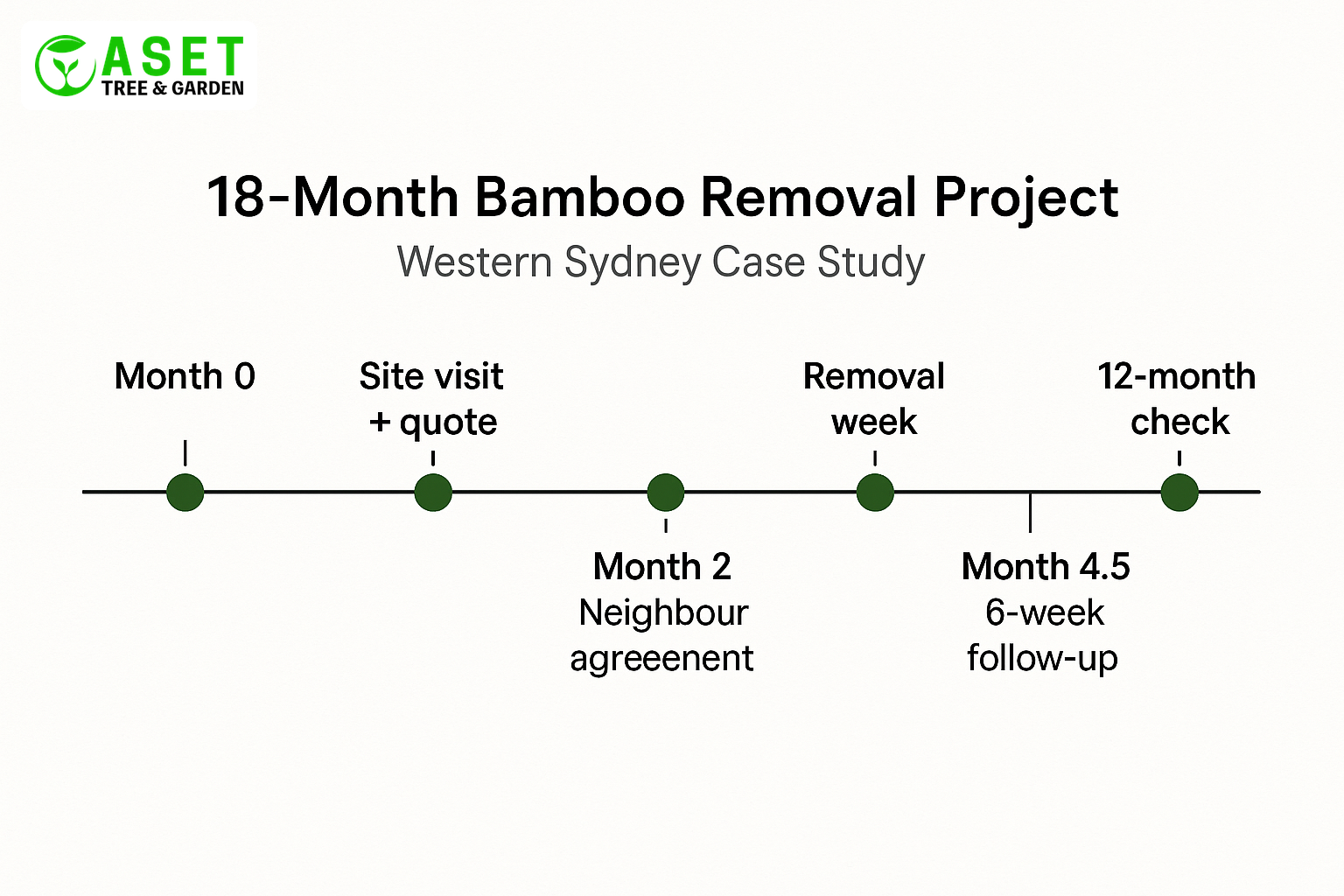
Most blog posts on bamboo removal talk about the process in the abstract. This one talks about a specific job. A property in Western Sydney came to us with established running bamboo that had been planted as a back-fence screen about a decade earlier, had crossed onto the neighbour’s side, and was lifting paving on both properties. The owner had attempted DIY removal twice and a one-day cut-back by a general arborist once before calling us. The full eradication programme ran 18 months. This is what those 18 months looked like.
Note: identifying details — exact suburb, specific property features, the customer’s name — have been generalised. The timeline, treatment schedule, and outcomes are accurate.
Spread: 7m of canopy, 9m of underground rhizome (mapped by probe)
Boundary status: Active source on neighbour’s side
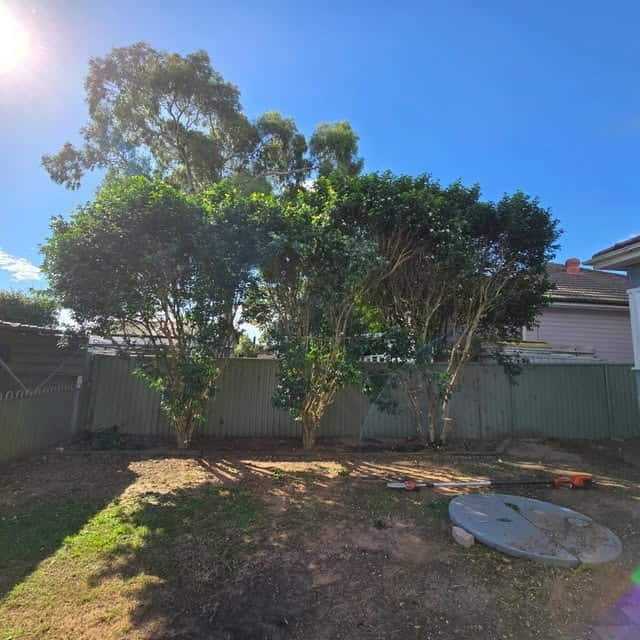
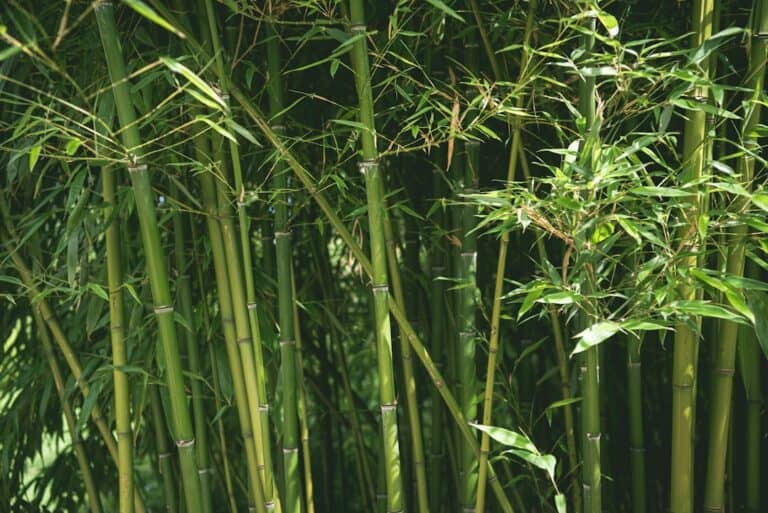
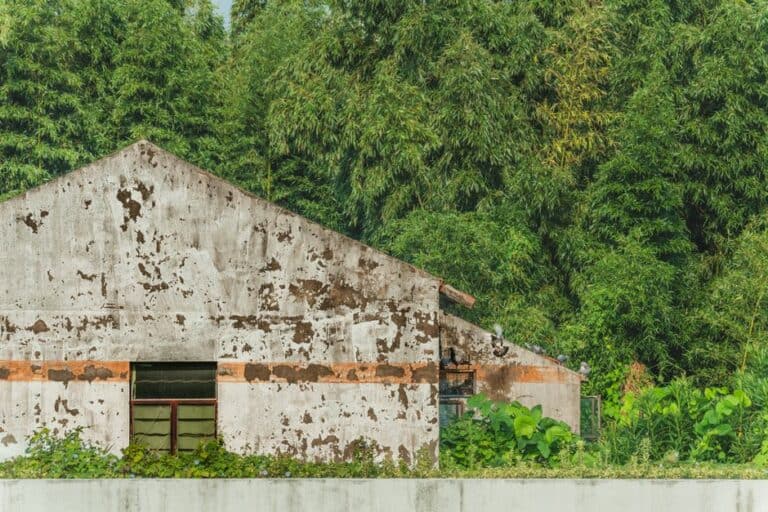
When we arrived for the initial quote visit, the situation was the kind we see often in established Western Sydney gardens. The original bamboo planting was Golden Bamboo (Phyllostachys aurea), the most common running variety in Sydney suburban gardens, planted roughly 12 years earlier along the back fence as a privacy screen. By the time we were called in, it had:
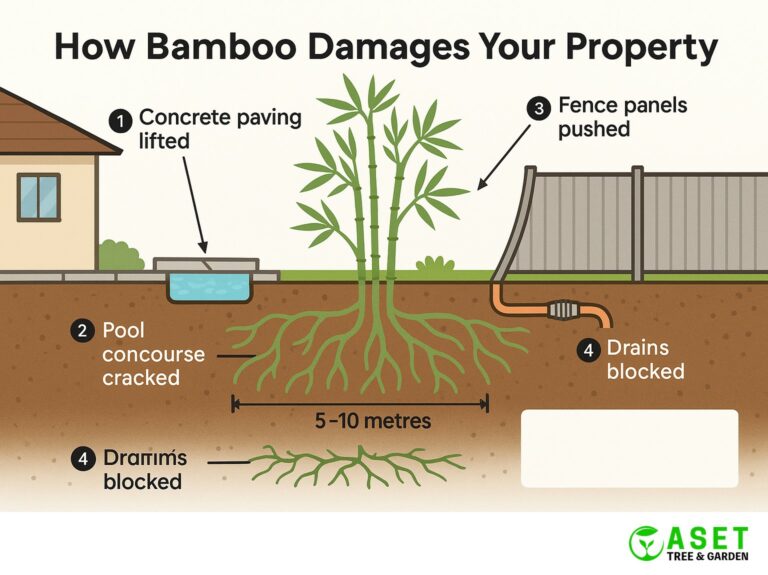
Spread along the entire 12-metre back fence to a depth of roughly 1.5 metres into the customer’s yard
Crossed under the fence into the neighbour’s property in three separate locations
Sent rhizomes through the lawn to emerge as scattered shoots up to 4 metres from the original plant
Begun to crack the concrete edge of the customer’s pool surround, where rhizomes had followed the edge of the pool shell
Started to lift two pavers near a sliding door, also from rhizome force
The customer had tried twice to remove it with a chainsaw and Roundup over the previous three years. Each time the bamboo came back within months. The third attempt was a general arborist who’d cut everything down to the ground in a single day, sprayed the cuts with general-purpose herbicide, charged $1,200, and disappeared. Within ten weeks new shoots were coming through.
The neighbour was approached — agreed in principle to joint treatment, was happy for us to work on their side under our customer’s contract, with the cost shared evenly. That cooperation made the whole programme dramatically simpler. Where we get neighbours who refuse to engage, the alternative is a root barrier installation (which we cover separately in our bamboo root barrier guide).
What Our Sydney Customers Say
I needed a yucca tree removed at my property in Pendle Hill and I am so glad I called ASET Tree Removal. From the very start, the experience was seamless. I was dealing with Amy and her team, who were incredibly professional, polite, and easy to communicate with. They made the entire process stress-free and provided a fair quote. The team did a fantastic job with the yucca removal including cleaning up perfectly. If you are looking for a reliable, hardworking, and friendly team for tree services, I cannot recommend ASET Tree Removal enough.
read moreread less
Joanne
12/18/2025
×
Joanne
12/18/2025
I needed a yucca tree removed at my property in Pendle Hill and I am so glad I called ASET Tree Removal. From the very start, the experience was seamless. I was dealing with Amy and her team, who were incredibly professional, polite, and easy to communicate with. They made the entire process stress-free and provided a fair quote. The team did a fantastic job with the yucca removal including cleaning up perfectly. If you are looking for a reliable, hardworking, and friendly team for tree services, I cannot recommend ASET Tree Removal enough.
Quoted for 100 metre's of hedging and removal of vegetation that had over grown onto a busy pedestrian footpath. The team at ASET were great, very professional, accommodating and friendly. Cleaned the site to perfection, did more then i expected, which was pleasant to see. Would highly recommend the ASET team and will definitely hire again for the next project.
read moreread less
Jake Trivor
8/05/2024
×
Jake Trivor
8/05/2024
Quoted for 100 metre's of hedging and removal of vegetation that had over grown onto a busy pedestrian footpath. The team at ASET were great, very professional, accommodating and friendly. Cleaned the site to perfection, did more then i expected, which was pleasant to see. Would highly recommend the ASET team and will definitely hire again for the next project.
I highly recommend ASET they gave our gardens the biggest face lift very happy with the job. I was completely impressed with their professionalism and customer service from start to finish. 10 Star
read moreread less
Yeet Pro
11/11/2024
×
Yeet Pro
11/11/2024
I highly recommend ASET they gave our gardens the biggest face lift very happy with the job. I was completely impressed with their professionalism and customer service from start to finish. 10 Star
Great team who does fantastic work. Came out to inspect, talked me through the work, kept me well informed during booking, before arriving and on the job. Very knowledgeable and professional. Job well done and easy recommendation. Will be retaining their services for ongoing work.
read moreread less
Kevin Tam
10/30/2025
×
Kevin Tam
10/30/2025
Great team who does fantastic work. Came out to inspect, talked me through the work, kept me well informed during booking, before arriving and on the job. Very knowledgeable and professional. Job well done and easy recommendation. Will be retaining their services for ongoing work.
Their service was fantastic from the first call to finishing the job. I needed 3 palm trees removed from my yard in Narellan Vale. I called and the customer service was very quick, polite, professional and helpful. I got the quote which was much cheaper than quoted elsewhere. They were able to come the next morning and did a great job removing the rubbish and tidying up. Highly recommend!
read moreread less
naomi gauld
1/23/2026
×
naomi gauld
1/23/2026
Their service was fantastic from the first call to finishing the job. I needed 3 palm trees removed from my yard in Narellan Vale. I called and the customer service was very quick, polite, professional and helpful. I got the quote which was much cheaper than quoted elsewhere. They were able to come the next morning and did a great job removing the rubbish and tidying up. Highly recommend!
A huge thank you to the ASET Team for looking after at every stage of taking care of my property. Very professional, punctual and honest. We look forward to using ASET in future and recommend their services to everyone looking for great work in bringing their property back to life! Thank you again.
read moreread less
Hussain Patel
11/01/2025
×
Hussain Patel
11/01/2025
A huge thank you to the ASET Team for looking after at every stage of taking care of my property. Very professional, punctual and honest. We look forward to using ASET in future and recommend their services to everyone looking for great work in bringing their property back to life! Thank you again.
From start to finish Ahmed And his team were extremely professional and extremely knowledgeable. We had some hedges trimmed down as they were too big to manage and my wife and I were very impressed with the work. Highly recommend to use ASET
read moreread less
Matthew Dawson
10/07/2025
×
Matthew Dawson
10/07/2025
From start to finish Ahmed And his team were extremely professional and extremely knowledgeable. We had some hedges trimmed down as they were too big to manage and my wife and I were very impressed with the work. Highly recommend to use ASET
The team were responsive and professional. Their quality of work was exceptional, thorough and suggestions were made while the original scope was being carried out that was extremely helpful. A detailed quote and scope of work was provided prior to commencement of the job.
read moreread less
Christina
12/23/2024
×
Christina
12/23/2024
The team were responsive and professional. Their quality of work was exceptional, thorough and suggestions were made while the original scope was being carried out that was extremely helpful. A detailed quote and scope of work was provided prior to commencement of the job.
Ahmad was very professional during quote and conduct of the job. He engaged with me at all stages to ensure the work was carried to out my requirements. Highly recommended.
read moreread less
Simon Harris
10/07/2025
×
Simon Harris
10/07/2025
Ahmad was very professional during quote and conduct of the job. He engaged with me at all stages to ensure the work was carried to out my requirements. Highly recommended.
ASET Tree Removal & Garden Rejuvenation did an amazing job of our whole complex’s multiple gardens. The whole team were friendly and professional, and Amy and Ahmed could not have been more accommodating. They communicated every step of the process and were happy to work with us to achieve a fantastic result that has lasted for months based on their recommendations. From quote to job completion, they were fantastic.
read moreread less
Lisa Santos
11/01/2024
×
Lisa Santos
11/01/2024
ASET Tree Removal & Garden Rejuvenation did an amazing job of our whole complex’s multiple gardens. The whole team were friendly and professional, and Amy and Ahmed could not have been more accommodating. They communicated every step of the process and were happy to work with us to achieve a fantastic result that has lasted for months based on their recommendations. From quote to job completion, they were fantastic.
Have a similar bamboo problem to this case study?
If your property looks anything like the one in this article, we want to talk. We work across Western Sydney every week and can usually quote within 48 hours.
The Step 1 quote (rhizome treatment phase) covered:
12 metres of back-fence bamboo + the neighbour’s adjacent strip
4-month initial treatment schedule, with monthly visits to cut and treat new shoots
A follow-on monthly visit for months 5–6 to confirm the rhizome was failing before progressing to Step 2
The Step 2 estimate (root ball extraction) was indicative — we don’t fix the price until we get there because the extraction effort depends on how well Step 1 worked. The Step 3 maintenance estimate was also indicative, billed per visit as needed.
The total programme estimate, ranged for the conversation, was between $5,800 and $8,500 split across the customer’s and neighbour’s contributions, over an expected 18–24 month timeline.
The customer’s reaction is one we hear often when we walk through the staged-quote model:
The fixed-price quote we’d had before was $3,500. Yours is more, but it’s the only one that’s been honest about how long it takes and what’s actually involved. We’ll go with you.
(That conversation isn’t from this specific job — I’ve paraphrased a comment we’ve heard many times — but it captures the typical customer reaction to honest staged pricing vs cheap one-day quotes.)
Months 1–6 — Step 1, rhizome treatment
“Great team who does fantastic work. Came out to inspect, talked me through the work, kept me well informed during booking, before arriving and on the job. Very knowledgeable and professional. Job well done and easy recommendation. Will be retaining their services for ongoing work.”
— Kevin, Regents Park · ★★★★★
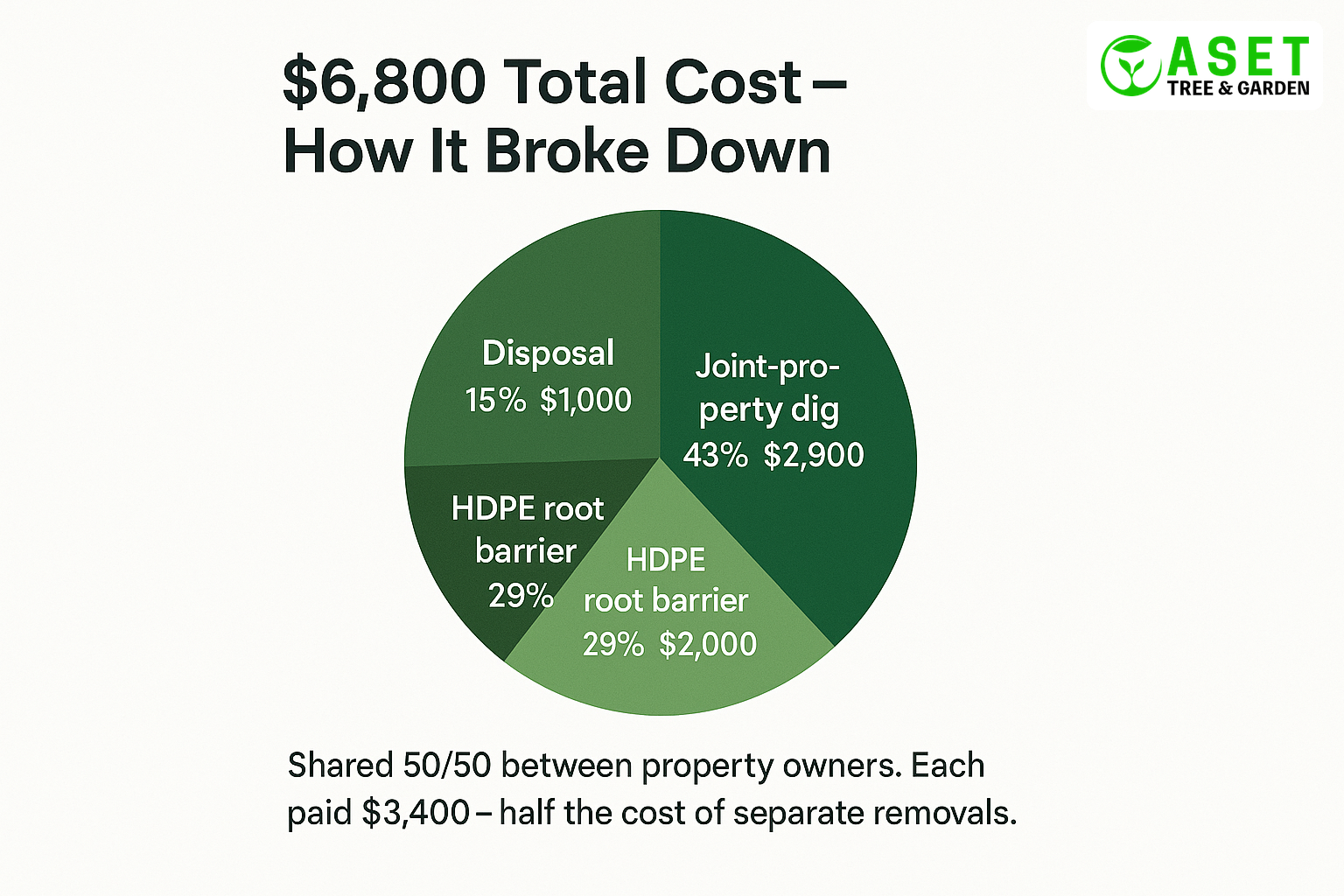
How the $6,800 was distributed across the work.
The first six months of any bamboo programme look the same. The crew arrived weekly for the first month, then fortnightly, cutting every visible shoot to ground level and injecting concentrated glyphosate into each freshly cut stem within seconds.
Visit 1 (Week 1): full cutback of the visible bamboo on both properties, every cane treated. Total of roughly 280 cane stems cut and injected on the first visit. The yard looked dramatically empty after Visit 1 — the customer’s first reaction was satisfaction, the team’s reaction was “now the real work starts.”
Visits 2–4 (Weeks 2–4): new shoots already emerging. Visit 2 found roughly 90 new shoots; Visit 3 found 60; Visit 4 found 35. The downward trend was what we wanted — the rhizome was spending its energy reserves on shoots that were getting cut and treated before they could photosynthesise.
Visits 5–12 (Months 2–4): fortnightly visits, declining shoot counts. By the end of month 4, individual visits were finding 5–10 new shoots — a fraction of what was coming up at the start. The rhizome’s stored energy was visibly running out.
Visits 13–18 (Months 5–6): monthly visits, mostly checking for isolated late shoots. Some visits found nothing at all. The above-ground bamboo was effectively gone; the underground rhizome network was no longer sending up viable shoots.
By month 6 we were satisfied that Step 1 had done its work. The rhizome was sufficiently exhausted that Step 2 (extraction) was now feasible — a live healthy rhizome network is rigidly anchored and immensely difficult to extract intact, while a chemically-depleted one comes out manageably.
Step 1 Shoot Counts (representative)
280
Visit 1 cuts
90
Visit 2 cuts
35
Visit 4 cuts
<5
Visit 12 cuts
Months 7–9 — Step 2, root ball extraction
The project at a glance
8 yrs
Stand age
before removal
240
Canes removed
4-6m tall
14 m
Root barrier
HDPE installed
$6.8k
Total project
split 50/50
What was actually removed
Canes: ~240 individual canes, 4-6m tall, chipped on site
Rhizome material: Approximately 380kg of green waste
HDPE root barrier: 14 metres installed at 600mm depth
Joint-property excavation: Both sides cleared in one operation
With the rhizome network now chemically exhausted, the extraction phase began. The work involved:
Hand-digging the rhizome network out of both properties, working systematically along the fence line and out into the yard wherever rhizomes had travelled
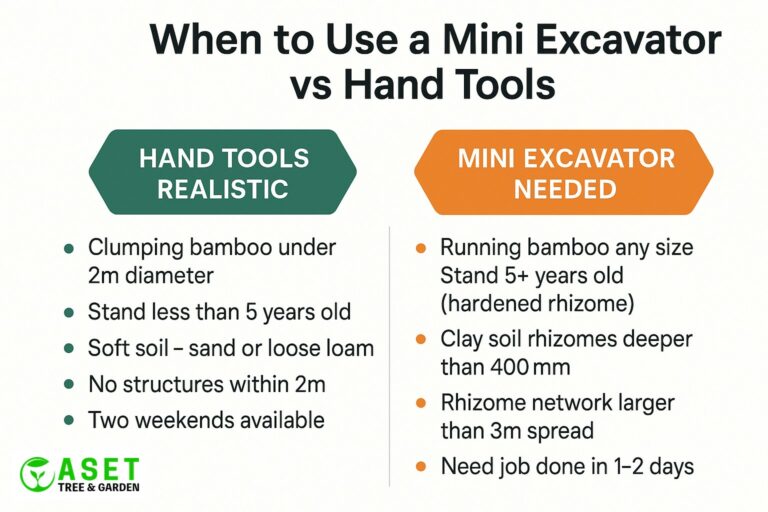
Manual extraction with shovels, mattocks, and root saws — no machinery, because the bamboo was in established garden beds (and on the neighbour’s side, the rhizomes had travelled under a brick path that we didn’t want to disturb)
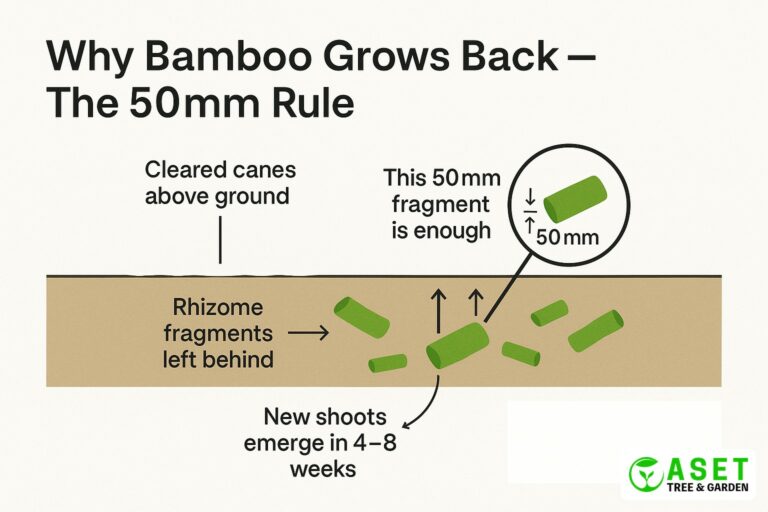
Tracing each rhizome to its end before cutting and removing, to minimise the chance of leaving fragments behind
Loading all removed material into trailer loads for landfill disposal — never composted, never mulched, never left on-site
Step 2 took about 8 working days across two crews over roughly 6 weeks (the work wasn’t continuous — we paused between visits to check that no new shoots were emerging from rhizomes we’d missed). The customer’s pool surround damage was repaired separately by a paving contractor after Step 2 was complete — by that point the rhizome force was gone and the repaired pavers would stay put.
The actual extracted root ball mass surprised the customer. Once we’d dug everything out, the pile of removed rhizome and root material filled three large trailer loads — far more material than the visible bamboo had suggested. This is typical, and it’s the visual proof point of why cutting the visible plant is never the same as removing the bamboo.
Months 10–18 — Step 3, maintenance phase
Step 3 looks anticlimactic by design. Quarterly visits for months 10, 13, 16, and 18 — we walked both properties, looking for any isolated new shoot that might have emerged from a missed rhizome fragment.
Months 10 and 13 each found one or two stray shoots. These were treated individually by the cut-stem injection method (same technique as Step 1, just on isolated shoots rather than a whole plant) and noted in the job log. Month 16 found nothing. Month 18 found nothing.
After Month 18 with no regrowth across two consecutive visits, we signed off on the eradication as complete. The customer was given a 12-month follow-up offer (free check-in visit at month 30 if any new shoots emerge — none have at the time of writing).
The total programme cost across both properties came in at roughly $7,200 — within the original quoted range, split between the customer and the neighbour. The customer’s share was around $3,800 across 18 months. Compared with the $1,200 paid to the previous arborist for a single-day cut-back that achieved nothing, the maths is straightforward.
Joint-property total: $6,800 (half each = $3,400 per owner)
Savings per owner: Approximately $4,500 each
Other benefit: Eliminates the source plant, no ongoing maintenance
A few things from this job that consistently apply across our bamboo work:
Neighbour cooperation is the single biggest cost-saver. Without the neighbour agreeing to joint treatment, this job would have required a root barrier install (additional $2,000–4,000) and would have taken longer because the rhizome source would have remained alive on the other side of the fence.
Step 1 shoot counts are the leading indicator of programme success. The declining curve of shoot counts visit-over-visit is what tells us the rhizome is running out of energy. A flat or rising shoot count would have meant we needed to adjust the treatment protocol or extend the timeline.
Step 3 is the step that competitors don’t do. A one-day cut-back operator might claim “we removed your bamboo” after Visit 1. They wouldn’t be there at Month 13 to spot the late stray shoot and treat it. That stray shoot is the rhizome fragment that would have regrown into the next infestation.
The customer’s confidence builds over the programme, not at the start. The first three months feel slow (“haven’t they removed it yet?”). By month 6 the customer starts to see the difference. By month 12 they’re recommending us to friends. By month 18 we have a customer for life.
A customer in Pendle Hill summarised the through-line of working with us this way:
“From the very start, the experience was seamless. I was dealing with Amy and her team, who were incredibly professional, polite, and easy to communicate with. They made the entire process stress-free and provided a fair quote. The team did a fantastic job.”
Great team who does fantastic work. Came out to inspect, talked me through the work, kept me well informed during booking, before arriving and on the job. Very knowledgeable and professional. Job well done and easy recommendation. Will be retaining their services for ongoing work.
read moreread less
Kevin Tam
10/30/2025
×
Kevin Tam
10/30/2025
Great team who does fantastic work. Came out to inspect, talked me through the work, kept me well informed during booking, before arriving and on the job. Very knowledgeable and professional. Job well done and easy recommendation. Will be retaining their services for ongoing work.
Amy and Ahmed worked in our garden for the first time today. They listened well to what we wanted, were great with communication and left the garden tidy and clean. We look forward to working with them again next month.
read moreread less
Elizabeth Spencer
8/07/2024
×
Elizabeth Spencer
8/07/2024
Amy and Ahmed worked in our garden for the first time today. They listened well to what we wanted, were great with communication and left the garden tidy and clean. We look forward to working with them again next month.
The team were responsive and professional. Their quality of work was exceptional, thorough and suggestions were made while the original scope was being carried out that was extremely helpful. A detailed quote and scope of work was provided prior to commencement of the job.
read moreread less
Christina
12/23/2024
×
Christina
12/23/2024
The team were responsive and professional. Their quality of work was exceptional, thorough and suggestions were made while the original scope was being carried out that was extremely helpful. A detailed quote and scope of work was provided prior to commencement of the job.
The team at ASET were great. Job was to remove 5 very large hedges. Very helpful while organising the quote and explained everything, very accommodating in scheduling, and were able to fit me in earlier than initially expected. Great communication throughout the whole process. The guys did a great job, very quick and efficient, and cleaned up after the job. Would definitely recommend or hire them again.
read moreread less
Courtnee Barnes
4/21/2024
×
Courtnee Barnes
4/21/2024
The team at ASET were great. Job was to remove 5 very large hedges. Very helpful while organising the quote and explained everything, very accommodating in scheduling, and were able to fit me in earlier than initially expected. Great communication throughout the whole process. The guys did a great job, very quick and efficient, and cleaned up after the job. Would definitely recommend or hire them again.
Excellent service. Amy and the team were wonderful to deal with right from the first call. The team provided us with a range of potential solutions based on our situation and ended up recommending us one which was the least costly. Along the way the communication from Amy was always clear. She always made time for us and answered any questions we had before we made any decisions. Highly recommend and would be happy to utilise them again for any future needs.
read moreread less
K L
12/23/2025
×
K L
12/23/2025
Excellent service. Amy and the team were wonderful to deal with right from the first call. The team provided us with a range of potential solutions based on our situation and ended up recommending us one which was the least costly. Along the way the communication from Amy was always clear. She always made time for us and answered any questions we had before we made any decisions. Highly recommend and would be happy to utilise them again for any future needs.
Very happy with the work done by Amy, Ahmads and their crew. They did a very thorough and clean, neat job on my garden as it required lots of manual weeding, spraying, whipper snipping etc due to having lots of pebbles, pavers, rocks etc. Very reasonably priced based on the long hours they put in and I would definitely call them back again for my next garden maintenance job.
read moreread less
veronica loh
10/07/2025
×
veronica loh
10/07/2025
Very happy with the work done by Amy, Ahmads and their crew. They did a very thorough and clean, neat job on my garden as it required lots of manual weeding, spraying, whipper snipping etc due to having lots of pebbles, pavers, rocks etc. Very reasonably priced based on the long hours they put in and I would definitely call them back again for my next garden maintenance job.
From start to finish Ahmed And his team were extremely professional and extremely knowledgeable. We had some hedges trimmed down as they were too big to manage and my wife and I were very impressed with the work. Highly recommend to use ASET
read moreread less
Matthew Dawson
10/07/2025
×
Matthew Dawson
10/07/2025
From start to finish Ahmed And his team were extremely professional and extremely knowledgeable. We had some hedges trimmed down as they were too big to manage and my wife and I were very impressed with the work. Highly recommend to use ASET
I needed a yucca tree removed at my property in Pendle Hill and I am so glad I called ASET Tree Removal. From the very start, the experience was seamless. I was dealing with Amy and her team, who were incredibly professional, polite, and easy to communicate with. They made the entire process stress-free and provided a fair quote. The team did a fantastic job with the yucca removal including cleaning up perfectly. If you are looking for a reliable, hardworking, and friendly team for tree services, I cannot recommend ASET Tree Removal enough.
read moreread less
Joanne
12/18/2025
×
Joanne
12/18/2025
I needed a yucca tree removed at my property in Pendle Hill and I am so glad I called ASET Tree Removal. From the very start, the experience was seamless. I was dealing with Amy and her team, who were incredibly professional, polite, and easy to communicate with. They made the entire process stress-free and provided a fair quote. The team did a fantastic job with the yucca removal including cleaning up perfectly. If you are looking for a reliable, hardworking, and friendly team for tree services, I cannot recommend ASET Tree Removal enough.
ASET Tree Removal & Garden Rejuvenation did an amazing job of our whole complex’s multiple gardens. The whole team were friendly and professional, and Amy and Ahmed could not have been more accommodating. They communicated every step of the process and were happy to work with us to achieve a fantastic result that has lasted for months based on their recommendations. From quote to job completion, they were fantastic.
read moreread less
Lisa Santos
11/01/2024
×
Lisa Santos
11/01/2024
ASET Tree Removal & Garden Rejuvenation did an amazing job of our whole complex’s multiple gardens. The whole team were friendly and professional, and Amy and Ahmed could not have been more accommodating. They communicated every step of the process and were happy to work with us to achieve a fantastic result that has lasted for months based on their recommendations. From quote to job completion, they were fantastic.
A huge thank you to the ASET Team for looking after at every stage of taking care of my property. Very professional, punctual and honest. We look forward to using ASET in future and recommend their services to everyone looking for great work in bringing their property back to life! Thank you again.
read moreread less
Hussain Patel
11/01/2025
×
Hussain Patel
11/01/2025
A huge thank you to the ASET Team for looking after at every stage of taking care of my property. Very professional, punctual and honest. We look forward to using ASET in future and recommend their services to everyone looking for great work in bringing their property back to life! Thank you again.
Quoted for 100 metre's of hedging and removal of vegetation that had over grown onto a busy pedestrian footpath. The team at ASET were great, very professional, accommodating and friendly. Cleaned the site to perfection, did more then i expected, which was pleasant to see. Would highly recommend the ASET team and will definitely hire again for the next project.
read moreread less
Jake Trivor
8/05/2024
×
Jake Trivor
8/05/2024
Quoted for 100 metre's of hedging and removal of vegetation that had over grown onto a busy pedestrian footpath. The team at ASET were great, very professional, accommodating and friendly. Cleaned the site to perfection, did more then i expected, which was pleasant to see. Would highly recommend the ASET team and will definitely hire again for the next project.
Amy and the team have been very helpful, they have removed a bougainville tree, orange, mulberry and olive tree that have failed to provide fruit for a number of years. I highly recommend ASET Tree Removal. Thank you.
read moreread less
anton barhy
5/10/2026
×
anton barhy
5/10/2026
Amy and the team have been very helpful, they have removed a bougainville tree, orange, mulberry and olive tree that have failed to provide fruit for a number of years. I highly recommend ASET Tree Removal. Thank you.
Working across Western Sydney every week
Parramatta, Penrith, Blacktown, Liverpool, Castle Hill, Campbelltown — we know the soil, the council rules, and the common bamboo varieties in each area.
The short answer is no. The longer answer is that the timeline is set by the rhizome biology, not by our schedule. We can’t speed up the chemical breakdown of the rhizome by treating more aggressively in Month 1 — the rhizome already has all the energy it has, and we have to wait for it to spend that energy on shoots that get killed. We CAN slow the timeline down by treating intermittently or missing visits, but the minimum time to fully exhaust an established running bamboo rhizome network in Sydney conditions is around 6 months of consistent Step 1 treatment.
The 18-month total includes Step 1 + Step 2 + Step 3. A property with no neighbour involvement and a smaller rhizome network could finish in 12 months. A property with a bigger network, multiple species, or harder access could stretch to 24–30 months. The 18-month figure is typical for a job of this size and complexity.
Bamboo Removal in Sydney
Specialist bamboo removal across Sydney and Western Sydney. Running bamboo, clumping bamboo, joint-property treatments, root barriers — done properly so it doesn’t come back.
“I needed a yucca tree removed at my property in Pendle Hill and I am so glad I called ASET Tree Removal. From the very start, the experience was seamless. I was dealing with Amy and her team, who were incredibly professional, polite, and easy to communicate with. They made the entire process stress-free and provided a fair quote.”
— Joanne, Pendle Hill · ★★★★★
Bamboo removal isn’t an emergency, but it is a commitment. At ASET Tree Removal, we run the programme honestly — staged quotes, realistic timelines, and consistent treatment that respects the underlying biology of the plant.
No pushy sales tactics. We have a friendly conversation, show you the lay of the land, and explain the different options available. You move forward at your own pace. People choose to work with us because we educate them on their options and help them feel confident about what will work best for them.
We’ll walk you through the realistic timeline for your situation so you know what you’ll commit to. We’ll explain the staged quote model so you understand exactly what you’re paying for at each step. And we’ll help you navigate the conversations that matter — including with neighbours, where joint treatment is the right path.
Our goal is straightforward. We want you to have a bamboo solution that works when you need it.
Get in touch with us today.
How We Work With You
Step 1: We Talk and Answer Your Questions
A friendly first call. We’ll listen to your situation and answer anything you want to know about the programme.
Step 2: We Inspect and Educate You on Your Options
A site visit to assess the bamboo, identify the species, map the rhizome direction, and check for neighbour involvement. We come back with realistic options.
Step 3: You Decide What Works Best
We talk through the options together. You choose the path that suits you.
Step 4: We Stay With You Through the Programme
We’re there for the full duration — every treatment visit, every check-in, until we sign off that the eradication is permanent.
ASET Tree Removal is a family-operated specialist vegetation business serving Sydney and Western Sydney. Ahmed is the head arborist — Cert3-qualified with 8+ years of field experience, leading every job on site. Amy handles client communication, quoting, and scheduling, making sure every property is handed back tidier than we found it. Together they run a business where one phone call gets you straight to the people doing the work.
Quoted for 100 metre's of hedging and removal of vegetation that had over grown onto a busy pedestrian footpath. The team at ASET were great, very professional, accommodating and friendly. Cleaned the site to perfection, did more then i expected, which was pleasant to see. Would highly recommend the ASET team and will definitely hire again for the next project.
read moreread less
Jake Trivor
8/05/2024
×
Jake Trivor
8/05/2024
Quoted for 100 metre's of hedging and removal of vegetation that had over grown onto a busy pedestrian footpath. The team at ASET were great, very professional, accommodating and friendly. Cleaned the site to perfection, did more then i expected, which was pleasant to see. Would highly recommend the ASET team and will definitely hire again for the next project.
I needed a yucca tree removed at my property in Pendle Hill and I am so glad I called ASET Tree Removal. From the very start, the experience was seamless. I was dealing with Amy and her team, who were incredibly professional, polite, and easy to communicate with. They made the entire process stress-free and provided a fair quote. The team did a fantastic job with the yucca removal including cleaning up perfectly. If you are looking for a reliable, hardworking, and friendly team for tree services, I cannot recommend ASET Tree Removal enough.
read moreread less
Joanne
12/18/2025
×
Joanne
12/18/2025
I needed a yucca tree removed at my property in Pendle Hill and I am so glad I called ASET Tree Removal. From the very start, the experience was seamless. I was dealing with Amy and her team, who were incredibly professional, polite, and easy to communicate with. They made the entire process stress-free and provided a fair quote. The team did a fantastic job with the yucca removal including cleaning up perfectly. If you are looking for a reliable, hardworking, and friendly team for tree services, I cannot recommend ASET Tree Removal enough.
I highly recommend ASET Tree Removal for all your garden needs, they are prompt, highly skilled and a pleasure to work with, thank you so much for your hard work
read moreread less
Violet Laubhan
9/05/2024
×
Violet Laubhan
9/05/2024
I highly recommend ASET Tree Removal for all your garden needs, they are prompt, highly skilled and a pleasure to work with, thank you so much for your hard work
Very happy with the work done by Amy, Ahmads and their crew. They did a very thorough and clean, neat job on my garden as it required lots of manual weeding, spraying, whipper snipping etc due to having lots of pebbles, pavers, rocks etc. Very reasonably priced based on the long hours they put in and I would definitely call them back again for my next garden maintenance job.
read moreread less
veronica loh
10/07/2025
×
veronica loh
10/07/2025
Very happy with the work done by Amy, Ahmads and their crew. They did a very thorough and clean, neat job on my garden as it required lots of manual weeding, spraying, whipper snipping etc due to having lots of pebbles, pavers, rocks etc. Very reasonably priced based on the long hours they put in and I would definitely call them back again for my next garden maintenance job.
ASET tree Removal’s work was fantastic!! From the initial enquiry to cut our tall hedge to the final product was second to none. Their attention to detail and good quality work was very appreciated. Will definitely use them again!!
read moreread less
K Dro
8/24/2024
×
K Dro
8/24/2024
ASET tree Removal’s work was fantastic!! From the initial enquiry to cut our tall hedge to the final product was second to none. Their attention to detail and good quality work was very appreciated. Will definitely use them again!!
Their service was fantastic from the first call to finishing the job. I needed 3 palm trees removed from my yard in Narellan Vale. I called and the customer service was very quick, polite, professional and helpful. I got the quote which was much cheaper than quoted elsewhere. They were able to come the next morning and did a great job removing the rubbish and tidying up. Highly recommend!
read moreread less
naomi gauld
1/23/2026
×
naomi gauld
1/23/2026
Their service was fantastic from the first call to finishing the job. I needed 3 palm trees removed from my yard in Narellan Vale. I called and the customer service was very quick, polite, professional and helpful. I got the quote which was much cheaper than quoted elsewhere. They were able to come the next morning and did a great job removing the rubbish and tidying up. Highly recommend!
Amy and the team have been very helpful, they have removed a bougainville tree, orange, mulberry and olive tree that have failed to provide fruit for a number of years. I highly recommend ASET Tree Removal. Thank you.
read moreread less
anton barhy
5/10/2026
×
anton barhy
5/10/2026
Amy and the team have been very helpful, they have removed a bougainville tree, orange, mulberry and olive tree that have failed to provide fruit for a number of years. I highly recommend ASET Tree Removal. Thank you.
A huge thank you to the ASET Team for looking after at every stage of taking care of my property. Very professional, punctual and honest. We look forward to using ASET in future and recommend their services to everyone looking for great work in bringing their property back to life! Thank you again.
read moreread less
Hussain Patel
11/01/2025
×
Hussain Patel
11/01/2025
A huge thank you to the ASET Team for looking after at every stage of taking care of my property. Very professional, punctual and honest. We look forward to using ASET in future and recommend their services to everyone looking for great work in bringing their property back to life! Thank you again.
They did a great job taking a stump off my garden. Communication was perfect, they went above and beyond to make sure everything was good. I will definitely get them and trust them to do my next jobs.
read moreread less
Pierro Saba
9/07/2024
×
Pierro Saba
9/07/2024
They did a great job taking a stump off my garden. Communication was perfect, they went above and beyond to make sure everything was good. I will definitely get them and trust them to do my next jobs.
I highly recommend ASET they gave our gardens the biggest face lift very happy with the job. I was completely impressed with their professionalism and customer service from start to finish. 10 Star
read moreread less
Yeet Pro
11/11/2024
×
Yeet Pro
11/11/2024
I highly recommend ASET they gave our gardens the biggest face lift very happy with the job. I was completely impressed with their professionalism and customer service from start to finish. 10 Star
Great team who does fantastic work. Came out to inspect, talked me through the work, kept me well informed during booking, before arriving and on the job. Very knowledgeable and professional. Job well done and easy recommendation. Will be retaining their services for ongoing work.
read moreread less
Kevin Tam
10/30/2025
×
Kevin Tam
10/30/2025
Great team who does fantastic work. Came out to inspect, talked me through the work, kept me well informed during booking, before arriving and on the job. Very knowledgeable and professional. Job well done and easy recommendation. Will be retaining their services for ongoing work.
The guys came out and trimmed a large hedge that I have. It’s roughly 20m long and 2.5m high and roughly 1.5m wide. The job they did was terrific. Not only trimming it, but leveling it out. I will definitely use their services again. Fantastic job. Thanks.
read moreread less
Paul N
12/04/2024
×
Paul N
12/04/2024
The guys came out and trimmed a large hedge that I have. It’s roughly 20m long and 2.5m high and roughly 1.5m wide. The job they did was terrific. Not only trimming it, but leveling it out. I will definitely use their services again. Fantastic job. Thanks.
Amy and Ahmed worked in our garden for the first time today. They listened well to what we wanted, were great with communication and left the garden tidy and clean. We look forward to working with them again next month.
read moreread less
Elizabeth Spencer
8/07/2024
×
Elizabeth Spencer
8/07/2024
Amy and Ahmed worked in our garden for the first time today. They listened well to what we wanted, were great with communication and left the garden tidy and clean. We look forward to working with them again next month.
ASET Tree Removal & Garden Rejuvenation did an amazing job of our whole complex’s multiple gardens. The whole team were friendly and professional, and Amy and Ahmed could not have been more accommodating. They communicated every step of the process and were happy to work with us to achieve a fantastic result that has lasted for months based on their recommendations. From quote to job completion, they were fantastic.
read moreread less
Lisa Santos
11/01/2024
×
Lisa Santos
11/01/2024
ASET Tree Removal & Garden Rejuvenation did an amazing job of our whole complex’s multiple gardens. The whole team were friendly and professional, and Amy and Ahmed could not have been more accommodating. They communicated every step of the process and were happy to work with us to achieve a fantastic result that has lasted for months based on their recommendations. From quote to job completion, they were fantastic.
From start to finish Ahmed And his team were extremely professional and extremely knowledgeable. We had some hedges trimmed down as they were too big to manage and my wife and I were very impressed with the work. Highly recommend to use ASET
read moreread less
Matthew Dawson
10/07/2025
×
Matthew Dawson
10/07/2025
From start to finish Ahmed And his team were extremely professional and extremely knowledgeable. We had some hedges trimmed down as they were too big to manage and my wife and I were very impressed with the work. Highly recommend to use ASET
The team at ASET were great. Job was to remove 5 very large hedges. Very helpful while organising the quote and explained everything, very accommodating in scheduling, and were able to fit me in earlier than initially expected. Great communication throughout the whole process. The guys did a great job, very quick and efficient, and cleaned up after the job. Would definitely recommend or hire them again.
read moreread less
Courtnee Barnes
4/21/2024
×
Courtnee Barnes
4/21/2024
The team at ASET were great. Job was to remove 5 very large hedges. Very helpful while organising the quote and explained everything, very accommodating in scheduling, and were able to fit me in earlier than initially expected. Great communication throughout the whole process. The guys did a great job, very quick and efficient, and cleaned up after the job. Would definitely recommend or hire them again.
They did an amazing job cleaning and organising my yard. They were really friendly, gave great advice and were fair priced. Thanks dor and awesome job. Highly recommend ASET Tree Removal.
read moreread less
Angelo Iannarilli
10/12/2024
×
Angelo Iannarilli
10/12/2024
They did an amazing job cleaning and organising my yard. They were really friendly, gave great advice and were fair priced. Thanks dor and awesome job. Highly recommend ASET Tree Removal.
Excellent service. Amy and the team were wonderful to deal with right from the first call. The team provided us with a range of potential solutions based on our situation and ended up recommending us one which was the least costly. Along the way the communication from Amy was always clear. She always made time for us and answered any questions we had before we made any decisions. Highly recommend and would be happy to utilise them again for any future needs.
read moreread less
K L
12/23/2025
×
K L
12/23/2025
Excellent service. Amy and the team were wonderful to deal with right from the first call. The team provided us with a range of potential solutions based on our situation and ended up recommending us one which was the least costly. Along the way the communication from Amy was always clear. She always made time for us and answered any questions we had before we made any decisions. Highly recommend and would be happy to utilise them again for any future needs.
Quick response with a quote.. Very friendly and Great work ethic and reasonable pricing. Highly recommend… Appreciate your help cleaning up our Backyard Garden and taking it away for us as well. Regards George
read moreread less
George Apostal
4/03/2024
×
George Apostal
4/03/2024
Quick response with a quote.. Very friendly and Great work ethic and reasonable pricing. Highly recommend… Appreciate your help cleaning up our Backyard Garden and taking it away for us as well. Regards George
Ahmad was very professional during quote and conduct of the job. He engaged with me at all stages to ensure the work was carried to out my requirements. Highly recommended.
read moreread less
Simon Harris
10/07/2025
×
Simon Harris
10/07/2025
Ahmad was very professional during quote and conduct of the job. He engaged with me at all stages to ensure the work was carried to out my requirements. Highly recommended.
Get a quote like the one in this case study
Free site assessment, written quote within 48 hours, all council compliance handled. We make the whole process simple — exactly like the case study above.
Information in the arboriculture industry changes frequently. Linked content may change or become outdated. Please always contact us for help with your important property decisions.
Five days spread across two visits — three days for the main excavation and two days for the boundary work and barrier installation. The 18 months covers the initial enquiry through the final 12-month regrowth check.
$6,800 including the joint-property dig, the HDPE root barrier installation along 14 metres of fence, and the included 6-week and 12-month follow-up visits.
Two small fragments at the 6-week mark, removed under the original quote. Nothing at the 12-month visit. The boundary barrier has held against the neighbour’s source.
Want a Sydney bamboo specialist to look at your stand? Free on-site visit, written quote within 48 hours.
Yes — the methodology scales. A single-property bamboo removal in a smaller yard would follow the same 3-stage process at proportionally lower cost.
Quote and approval phase took 6 weeks while the neighbour was consulted. The dig itself was a week. The 6-week follow-up and 12-month check pushed the closure date out to 18 months from initial contact.