“Why don’t you just bring in an excavator?” is a question we get often, especially on big bamboo jobs where the visible plant looks like a wall of canes. The answer is: sometimes we do, but for most Sydney bamboo removals, manual extraction is the right call. The reason has less to do with the bamboo itself and more to do with where it tends to grow — and what’s around it that we don’t want to wreck.
The fundamental trade-off
Side gate width quick reference
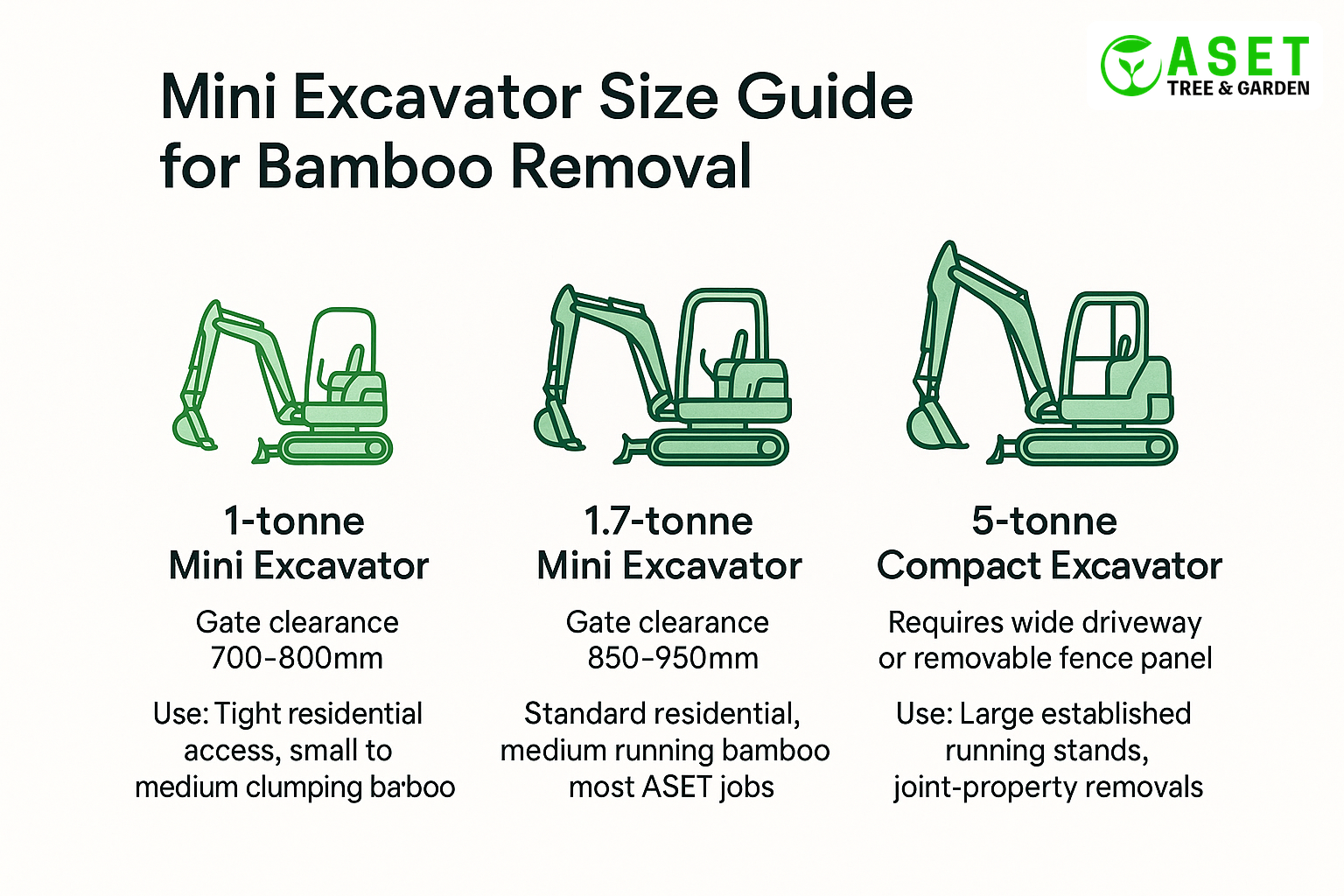
700-800mm gate: 1-tonne mini excavator fits.
850-950mm gate: Both 1-tonne and 1.7-tonne fit.
Below 700mm: Hand tools only, or temporarily remove a fence panel.
Manual removal is slower but precise. Hand tools (shovels, mattocks, root saws) let us extract the bamboo without disturbing the surrounding garden bed, paving, fence posts, or root systems of nearby plants. The labour cost is higher because it takes longer.
Mechanical removal (mini-excavator, skid steer) is faster but destructive. The machine doesn’t distinguish between bamboo roots and your retaining wall, your sprinkler pipes, or the roots of the camellia next to it. Machines also need vehicle access wide enough to manoeuvre, which most suburban properties don’t have through the side gate.
The right choice depends on the answer to one question: what’s around the bamboo that you don’t want destroyed?
What Our Sydney Customers Say
Ahmad was very professional during quote and conduct of the job. He engaged with me at all stages to ensure the work was carried to out my requirements. Highly recommended.
read moreread less
Simon Harris
10/07/2025
×
Simon Harris
10/07/2025
Ahmad was very professional during quote and conduct of the job. He engaged with me at all stages to ensure the work was carried to out my requirements. Highly recommended.
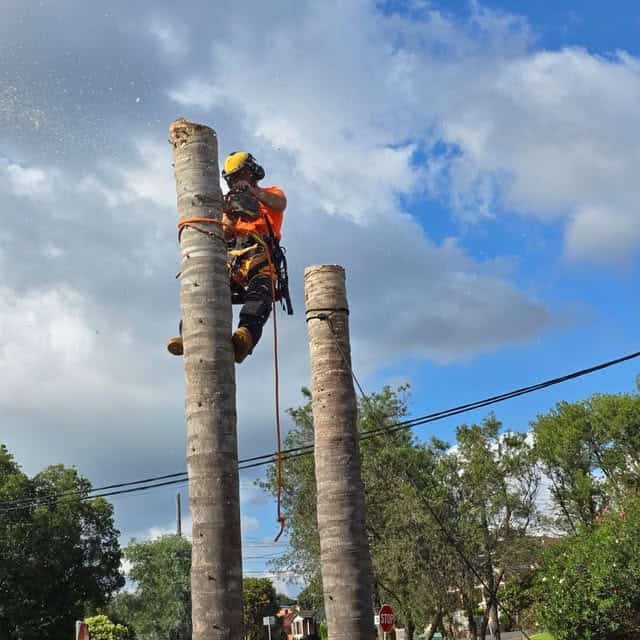
Their service was fantastic from the first call to finishing the job. I needed 3 palm trees removed from my yard in Narellan Vale. I called and the customer service was very quick, polite, professional and helpful. I got the quote which was much cheaper than quoted elsewhere. They were able to come the next morning and did a great job removing the rubbish and tidying up. Highly recommend!
read moreread less
naomi gauld
1/23/2026
×
naomi gauld
1/23/2026
Their service was fantastic from the first call to finishing the job. I needed 3 palm trees removed from my yard in Narellan Vale. I called and the customer service was very quick, polite, professional and helpful. I got the quote which was much cheaper than quoted elsewhere. They were able to come the next morning and did a great job removing the rubbish and tidying up. Highly recommend!
Great team who does fantastic work. Came out to inspect, talked me through the work, kept me well informed during booking, before arriving and on the job. Very knowledgeable and professional. Job well done and easy recommendation. Will be retaining their services for ongoing work.
read moreread less
Kevin Tam
10/30/2025
×
Kevin Tam
10/30/2025
Great team who does fantastic work. Came out to inspect, talked me through the work, kept me well informed during booking, before arriving and on the job. Very knowledgeable and professional. Job well done and easy recommendation. Will be retaining their services for ongoing work.
ASET Tree Removal & Garden Rejuvenation did an amazing job of our whole complex’s multiple gardens. The whole team were friendly and professional, and Amy and Ahmed could not have been more accommodating. They communicated every step of the process and were happy to work with us to achieve a fantastic result that has lasted for months based on their recommendations. From quote to job completion, they were fantastic.
read moreread less
Lisa Santos
11/01/2024
×
Lisa Santos
11/01/2024
ASET Tree Removal & Garden Rejuvenation did an amazing job of our whole complex’s multiple gardens. The whole team were friendly and professional, and Amy and Ahmed could not have been more accommodating. They communicated every step of the process and were happy to work with us to achieve a fantastic result that has lasted for months based on their recommendations. From quote to job completion, they were fantastic.
From start to finish Ahmed And his team were extremely professional and extremely knowledgeable. We had some hedges trimmed down as they were too big to manage and my wife and I were very impressed with the work. Highly recommend to use ASET
read moreread less
Matthew Dawson
10/07/2025
×
Matthew Dawson
10/07/2025
From start to finish Ahmed And his team were extremely professional and extremely knowledgeable. We had some hedges trimmed down as they were too big to manage and my wife and I were very impressed with the work. Highly recommend to use ASET
I needed a yucca tree removed at my property in Pendle Hill and I am so glad I called ASET Tree Removal. From the very start, the experience was seamless. I was dealing with Amy and her team, who were incredibly professional, polite, and easy to communicate with. They made the entire process stress-free and provided a fair quote. The team did a fantastic job with the yucca removal including cleaning up perfectly. If you are looking for a reliable, hardworking, and friendly team for tree services, I cannot recommend ASET Tree Removal enough.
read moreread less
Joanne
12/18/2025
×
Joanne
12/18/2025
I needed a yucca tree removed at my property in Pendle Hill and I am so glad I called ASET Tree Removal. From the very start, the experience was seamless. I was dealing with Amy and her team, who were incredibly professional, polite, and easy to communicate with. They made the entire process stress-free and provided a fair quote. The team did a fantastic job with the yucca removal including cleaning up perfectly. If you are looking for a reliable, hardworking, and friendly team for tree services, I cannot recommend ASET Tree Removal enough.
A huge thank you to the ASET Team for looking after at every stage of taking care of my property. Very professional, punctual and honest. We look forward to using ASET in future and recommend their services to everyone looking for great work in bringing their property back to life! Thank you again.
read moreread less
Hussain Patel
11/01/2025
×
Hussain Patel
11/01/2025
A huge thank you to the ASET Team for looking after at every stage of taking care of my property. Very professional, punctual and honest. We look forward to using ASET in future and recommend their services to everyone looking for great work in bringing their property back to life! Thank you again.
The team were responsive and professional. Their quality of work was exceptional, thorough and suggestions were made while the original scope was being carried out that was extremely helpful. A detailed quote and scope of work was provided prior to commencement of the job.
read moreread less
Christina
12/23/2024
×
Christina
12/23/2024
The team were responsive and professional. Their quality of work was exceptional, thorough and suggestions were made while the original scope was being carried out that was extremely helpful. A detailed quote and scope of work was provided prior to commencement of the job.
I highly recommend ASET they gave our gardens the biggest face lift very happy with the job. I was completely impressed with their professionalism and customer service from start to finish. 10 Star
read moreread less
Yeet Pro
11/11/2024
×
Yeet Pro
11/11/2024
I highly recommend ASET they gave our gardens the biggest face lift very happy with the job. I was completely impressed with their professionalism and customer service from start to finish. 10 Star
Quoted for 100 metre's of hedging and removal of vegetation that had over grown onto a busy pedestrian footpath. The team at ASET were great, very professional, accommodating and friendly. Cleaned the site to perfection, did more then i expected, which was pleasant to see. Would highly recommend the ASET team and will definitely hire again for the next project.
read moreread less
Jake Trivor
8/05/2024
×
Jake Trivor
8/05/2024
Quoted for 100 metre's of hedging and removal of vegetation that had over grown onto a busy pedestrian footpath. The team at ASET were great, very professional, accommodating and friendly. Cleaned the site to perfection, did more then i expected, which was pleasant to see. Would highly recommend the ASET team and will definitely hire again for the next project.
Need a job that’s beyond hand tools?
We own the 1-tonne, 1.7-tonne, and 3-tonne machines. We assess your site access (gate width, driveway) and bring the right size — no guessing, no rental delays.
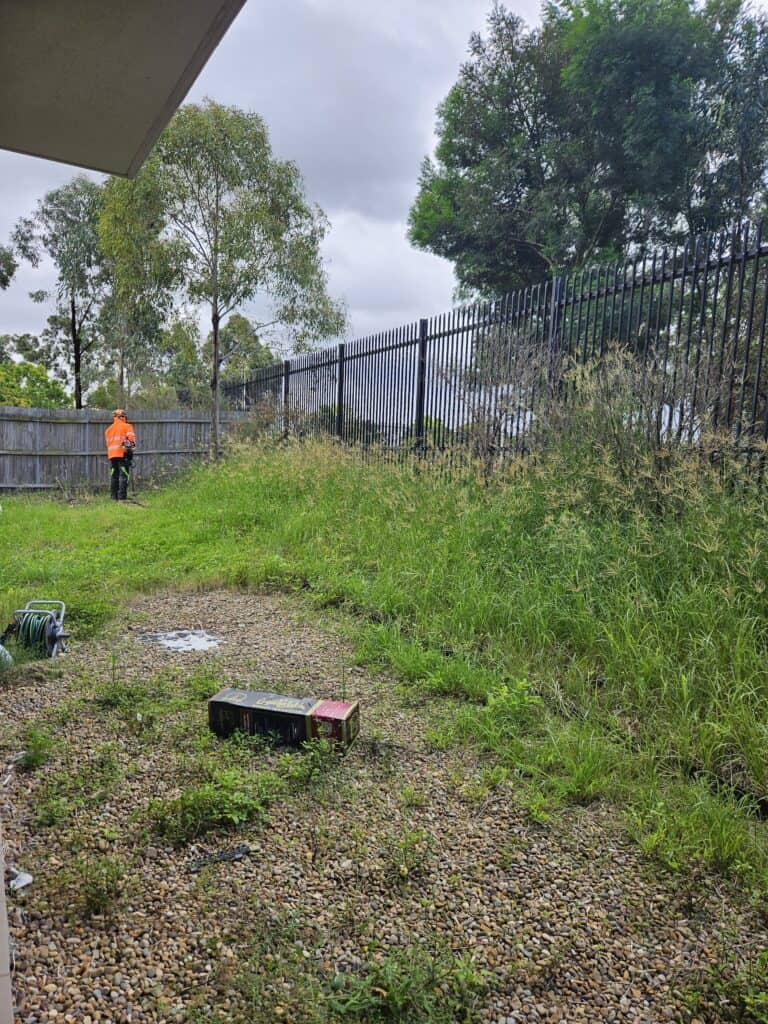
Most suburban Sydney bamboo lives in established garden beds — along a back fence, around a pool, next to a path. In these locations, manual extraction is the default because:
Garden beds contain other plants you want to keep. A mini-excavator working in a 1.5-metre-wide bed will destroy everything around the bamboo.
Paving and pool surrounds sit on compacted base material that machines disturb. Working a machine within a metre of paving usually means having to re-set the paving afterward.
Sprinkler pipes and electrical conduits sit shallow in most Sydney gardens. Manual digging finds them; machine digging breaks them.
Fence posts and retaining walls have foundations that can be undermined by machine work alongside them.
Mature trees nearby have surface roots that get torn up by machinery — sometimes killing the tree.
For these reasons, the ASET 3-Step Bamboo Eradication Programme uses manual extraction as the standard approach for Step 2 (root ball removal).
When mechanical removal makes sense
Choose the right machine for the job.
There are situations where bringing in a machine is the right call:
Open land with no surrounding garden infrastructure. Pre-construction land clearing, rural blocks, paddocks. The bamboo is in the open with nothing to protect, and machine speed wins.
Very large established bamboo plantations (over 50 square metres of continuous bamboo) on a property with vehicle access. The labour cost of manual extraction at that scale starts to overwhelm the precision benefit.
Bamboo on a verge or street frontage with no garden bed to protect. Machines can work straight off the street into the area.
Combined land clearing jobs where the bamboo is one element of a larger site clearing — pre-construction or property prep for sale.
In Sydney, only a small fraction of bamboo removal jobs hit those criteria. Most are suburban gardens where manual is the better choice.
What “manual” actually involves
“Great team who does fantastic work. Came out to inspect, talked me through the work, kept me well informed during booking, before arriving and on the job. Very knowledgeable and professional. Job well done and easy recommendation. Will be retaining their services for ongoing work.”
— Kevin, Regents Park · ★★★★★
Cost difference: hand vs machine excavation
Small clumping (hand): $500-$900 — half day, single operator.
Large running (1.7-tonne machine): $4,000-$8,000 — 3-5 days, full crew.
Property clearance (5-tonne): $8,000+ — multi-day, depending on volume.
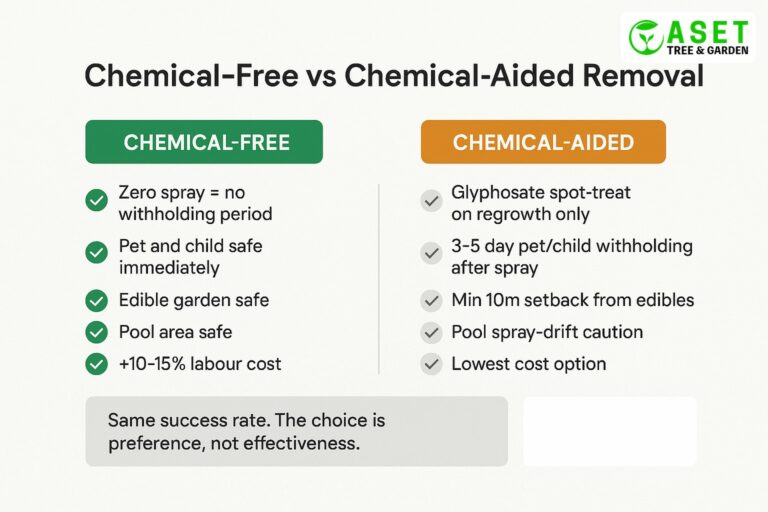
Step 1 (rhizome treatment) and Step 3 (maintenance) of the eradication programme are entirely hand work — cutting individual shoots and applying concentrated glyphosate via cut-stem injection. There’s no mechanical alternative for this phase because the work is on individual shoots, not bulk biomass.
Step 2 (root ball extraction) is the heavy labour phase. Hand tools we use:
Sharp spade for digging out the rhizome network from above
Mattock for breaking up compacted soil around the root ball
Root saw for cutting through dense rhizome clusters
Loppers for any remaining cane fragments
Wheelbarrows / trailer for hauling extracted material
A typical Sydney suburban bamboo extraction takes 1 to 3 days of two-person crew work for a clump of 5-10 square metres that’s been chemically depleted via Step 1. Larger or denser jobs scale up from there.
What happens to extracted bamboo
Excavator job by the numbers
1 t
Smallest machine
700mm gate
5 t
Largest residential
driveway access
50%
Time saving
vs hand digging
$300
Daily hire
DIY excavator hire
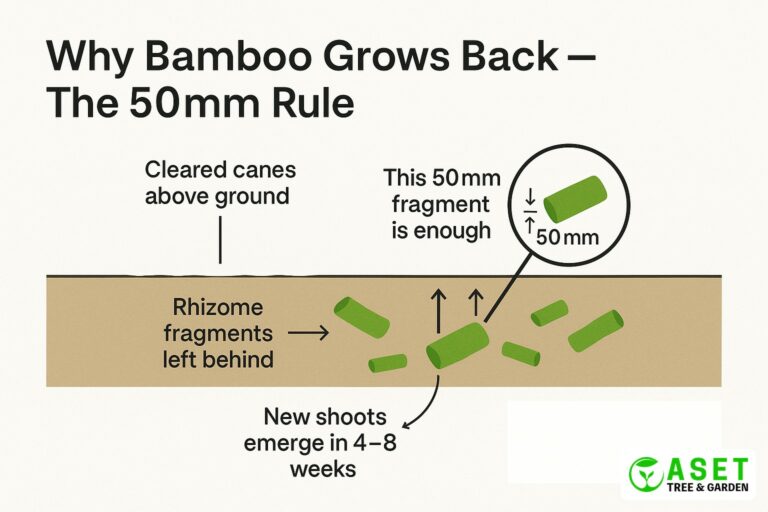
All extracted bamboo material — canes, rhizomes, root fragments — goes to landfill. Never composted, never mulched on-site, never left in green-waste bins for council collection. The reason is fragment regrowth: bamboo rhizomes can sprout from small fragments under the right conditions, and any disposal route that leaves the material accessible to soil creates a risk of unintended re-establishment.
Hauling cost is included in our quote.
The mechanical-on-a-machine question
What a 5-tonne machine adds vs 1.7-tonne
Roughly 2x the lift capacity per arm extension — better for dense old-growth rhizome mats.
Faster trench excavation for boundary barriers.
Can handle stump grinding integration on the same job.
Reduces total on-site days by 30-50% for large stands.
Sometimes customers ask whether we can “rip out the bamboo with a stump grinder” or “use a wood chipper on the canes”. A few practical answers:
Stump grinders are designed for tree stumps with a clean above-ground target. Bamboo’s underground rhizome network spreads horizontally several metres — there’s no single “stump” to grind. Grinding the visible canes does nothing to the rhizome.
Wood chippers handle the cut canes well, but chipped bamboo is exactly the disposal problem to avoid — small pieces of bamboo are perfect for re-sprouting. We don’t chip bamboo on-site for that reason.
Brush cutters and chainsaws are useful for the initial above-ground cutback in Step 1, but again, they only handle the visible plant, not the rhizome.
The pattern: there’s no mechanical shortcut that bypasses the rhizome biology. Whatever you do above ground, the underground network still has to be killed before permanent removal is possible.
What this means for your quote
When we visit your property for a bamboo quote, we’ll assess:
The bamboo’s location relative to garden beds, paving, pool, fences, pipes, and nearby plants
Vehicle access (can a small machine even get to the site?)
Total bamboo footprint (square metres of continuous coverage)
Whether the property is a candidate for any mechanical assistance, or 100% manual
Most quotes come back as fully manual work, which the cost reflects — manual labour is the dominant cost component. For the rare jobs where mechanical assistance is appropriate, we’ll quote both options so you can see the trade-off.
What Our Sydney Customers Say
Very happy with the work done by Amy, Ahmads and their crew. They did a very thorough and clean, neat job on my garden as it required lots of manual weeding, spraying, whipper snipping etc due to having lots of pebbles, pavers, rocks etc. Very reasonably priced based on the long hours they put in and I would definitely call them back again for my next garden maintenance job.
read moreread less
veronica loh
10/07/2025
×
veronica loh
10/07/2025
Very happy with the work done by Amy, Ahmads and their crew. They did a very thorough and clean, neat job on my garden as it required lots of manual weeding, spraying, whipper snipping etc due to having lots of pebbles, pavers, rocks etc. Very reasonably priced based on the long hours they put in and I would definitely call them back again for my next garden maintenance job.
Amy and the team have been very helpful, they have removed a bougainville tree, orange, mulberry and olive tree that have failed to provide fruit for a number of years. I highly recommend ASET Tree Removal. Thank you.
read moreread less
anton barhy
5/10/2026
×
anton barhy
5/10/2026
Amy and the team have been very helpful, they have removed a bougainville tree, orange, mulberry and olive tree that have failed to provide fruit for a number of years. I highly recommend ASET Tree Removal. Thank you.
I needed a yucca tree removed at my property in Pendle Hill and I am so glad I called ASET Tree Removal. From the very start, the experience was seamless. I was dealing with Amy and her team, who were incredibly professional, polite, and easy to communicate with. They made the entire process stress-free and provided a fair quote. The team did a fantastic job with the yucca removal including cleaning up perfectly. If you are looking for a reliable, hardworking, and friendly team for tree services, I cannot recommend ASET Tree Removal enough.
read moreread less
Joanne
12/18/2025
×
Joanne
12/18/2025
I needed a yucca tree removed at my property in Pendle Hill and I am so glad I called ASET Tree Removal. From the very start, the experience was seamless. I was dealing with Amy and her team, who were incredibly professional, polite, and easy to communicate with. They made the entire process stress-free and provided a fair quote. The team did a fantastic job with the yucca removal including cleaning up perfectly. If you are looking for a reliable, hardworking, and friendly team for tree services, I cannot recommend ASET Tree Removal enough.
A huge thank you to the ASET Team for looking after at every stage of taking care of my property. Very professional, punctual and honest. We look forward to using ASET in future and recommend their services to everyone looking for great work in bringing their property back to life! Thank you again.
read moreread less
Hussain Patel
11/01/2025
×
Hussain Patel
11/01/2025
A huge thank you to the ASET Team for looking after at every stage of taking care of my property. Very professional, punctual and honest. We look forward to using ASET in future and recommend their services to everyone looking for great work in bringing their property back to life! Thank you again.
Excellent service. Amy and the team were wonderful to deal with right from the first call. The team provided us with a range of potential solutions based on our situation and ended up recommending us one which was the least costly. Along the way the communication from Amy was always clear. She always made time for us and answered any questions we had before we made any decisions. Highly recommend and would be happy to utilise them again for any future needs.
read moreread less
K L
12/23/2025
×
K L
12/23/2025
Excellent service. Amy and the team were wonderful to deal with right from the first call. The team provided us with a range of potential solutions based on our situation and ended up recommending us one which was the least costly. Along the way the communication from Amy was always clear. She always made time for us and answered any questions we had before we made any decisions. Highly recommend and would be happy to utilise them again for any future needs.
Quoted for 100 metre's of hedging and removal of vegetation that had over grown onto a busy pedestrian footpath. The team at ASET were great, very professional, accommodating and friendly. Cleaned the site to perfection, did more then i expected, which was pleasant to see. Would highly recommend the ASET team and will definitely hire again for the next project.
read moreread less
Jake Trivor
8/05/2024
×
Jake Trivor
8/05/2024
Quoted for 100 metre's of hedging and removal of vegetation that had over grown onto a busy pedestrian footpath. The team at ASET were great, very professional, accommodating and friendly. Cleaned the site to perfection, did more then i expected, which was pleasant to see. Would highly recommend the ASET team and will definitely hire again for the next project.
The team were responsive and professional. Their quality of work was exceptional, thorough and suggestions were made while the original scope was being carried out that was extremely helpful. A detailed quote and scope of work was provided prior to commencement of the job.
read moreread less
Christina
12/23/2024
×
Christina
12/23/2024
The team were responsive and professional. Their quality of work was exceptional, thorough and suggestions were made while the original scope was being carried out that was extremely helpful. A detailed quote and scope of work was provided prior to commencement of the job.
From start to finish Ahmed And his team were extremely professional and extremely knowledgeable. We had some hedges trimmed down as they were too big to manage and my wife and I were very impressed with the work. Highly recommend to use ASET
read moreread less
Matthew Dawson
10/07/2025
×
Matthew Dawson
10/07/2025
From start to finish Ahmed And his team were extremely professional and extremely knowledgeable. We had some hedges trimmed down as they were too big to manage and my wife and I were very impressed with the work. Highly recommend to use ASET
The team at ASET were great. Job was to remove 5 very large hedges. Very helpful while organising the quote and explained everything, very accommodating in scheduling, and were able to fit me in earlier than initially expected. Great communication throughout the whole process. The guys did a great job, very quick and efficient, and cleaned up after the job. Would definitely recommend or hire them again.
read moreread less
Courtnee Barnes
4/21/2024
×
Courtnee Barnes
4/21/2024
The team at ASET were great. Job was to remove 5 very large hedges. Very helpful while organising the quote and explained everything, very accommodating in scheduling, and were able to fit me in earlier than initially expected. Great communication throughout the whole process. The guys did a great job, very quick and efficient, and cleaned up after the job. Would definitely recommend or hire them again.
ASET Tree Removal & Garden Rejuvenation did an amazing job of our whole complex’s multiple gardens. The whole team were friendly and professional, and Amy and Ahmed could not have been more accommodating. They communicated every step of the process and were happy to work with us to achieve a fantastic result that has lasted for months based on their recommendations. From quote to job completion, they were fantastic.
read moreread less
Lisa Santos
11/01/2024
×
Lisa Santos
11/01/2024
ASET Tree Removal & Garden Rejuvenation did an amazing job of our whole complex’s multiple gardens. The whole team were friendly and professional, and Amy and Ahmed could not have been more accommodating. They communicated every step of the process and were happy to work with us to achieve a fantastic result that has lasted for months based on their recommendations. From quote to job completion, they were fantastic.
Amy and Ahmed worked in our garden for the first time today. They listened well to what we wanted, were great with communication and left the garden tidy and clean. We look forward to working with them again next month.
read moreread less
Elizabeth Spencer
8/07/2024
×
Elizabeth Spencer
8/07/2024
Amy and Ahmed worked in our garden for the first time today. They listened well to what we wanted, were great with communication and left the garden tidy and clean. We look forward to working with them again next month.
Great team who does fantastic work. Came out to inspect, talked me through the work, kept me well informed during booking, before arriving and on the job. Very knowledgeable and professional. Job well done and easy recommendation. Will be retaining their services for ongoing work.
read moreread less
Kevin Tam
10/30/2025
×
Kevin Tam
10/30/2025
Great team who does fantastic work. Came out to inspect, talked me through the work, kept me well informed during booking, before arriving and on the job. Very knowledgeable and professional. Job well done and easy recommendation. Will be retaining their services for ongoing work.
The right machine for your site, on day one
Free site visit. We measure your gates, check ground conditions, and write a fixed quote with the exact equipment you’ll see on the day. No swaps, no surprises.
“I was dealing with Amy and her team, who were incredibly professional, polite, and easy to communicate with. They made the entire process stress-free and provided a fair quote. The team did a fantastic job with the yucca removal including cleaning up perfectly.”
(The job referenced was yucca rather than bamboo, but the same hand-work approach applies to specialist plant removal in established garden beds.)
The shortcut that doesn’t exist
Mini excavator sizes for bamboo removal
Machine size
Gate clearance
Best for
Day rate (operator + machine)
1-tonne
700-800mm
Tight residential access, small-medium clumping
$650-$850
1.7-tonne
850-950mm
Standard residential, medium running, most ASET jobs
$850-$1,200
3-tonne
1.2m wide
Larger gardens, joint-property jobs
$1,200-$1,500
5-tonne
Open driveway
Large established running stands, fast clears
$1,500-$2,000
The honest summary: there’s no magic mechanical method that makes bamboo removal fast. The plant’s biology means permanent removal is a multi-month or multi-year programme of consistent chemical treatment followed by careful manual extraction. Operators who promise a one-day mechanical fix are either misrepresenting what they’ll achieve, or they’ll deliver something that comes back within a year.
Bamboo Removal in Sydney
Specialist bamboo removal across Sydney and Western Sydney. Running bamboo, clumping bamboo, joint-property treatments, root barriers — done properly so it doesn’t come back.
“I needed a yucca tree removed at my property in Pendle Hill and I am so glad I called ASET Tree Removal. From the very start, the experience was seamless. I was dealing with Amy and her team, who were incredibly professional, polite, and easy to communicate with. They made the entire process stress-free and provided a fair quote.”
ASET Tree Removal is a family-operated specialist vegetation business serving Sydney and Western Sydney. Ahmed is the head arborist — Cert3-qualified with 8+ years of field experience, leading every job on site. Amy handles client communication, quoting, and scheduling, making sure every property is handed back tidier than we found it. Together they run a business where one phone call gets you straight to the people doing the work.
ASET tree Removal’s work was fantastic!! From the initial enquiry to cut our tall hedge to the final product was second to none. Their attention to detail and good quality work was very appreciated. Will definitely use them again!!
read moreread less
K Dro
8/24/2024
×
K Dro
8/24/2024
ASET tree Removal’s work was fantastic!! From the initial enquiry to cut our tall hedge to the final product was second to none. Their attention to detail and good quality work was very appreciated. Will definitely use them again!!
From start to finish Ahmed And his team were extremely professional and extremely knowledgeable. We had some hedges trimmed down as they were too big to manage and my wife and I were very impressed with the work. Highly recommend to use ASET
read moreread less
Matthew Dawson
10/07/2025
×
Matthew Dawson
10/07/2025
From start to finish Ahmed And his team were extremely professional and extremely knowledgeable. We had some hedges trimmed down as they were too big to manage and my wife and I were very impressed with the work. Highly recommend to use ASET
Excellent service. Amy and the team were wonderful to deal with right from the first call. The team provided us with a range of potential solutions based on our situation and ended up recommending us one which was the least costly. Along the way the communication from Amy was always clear. She always made time for us and answered any questions we had before we made any decisions. Highly recommend and would be happy to utilise them again for any future needs.
read moreread less
K L
12/23/2025
×
K L
12/23/2025
Excellent service. Amy and the team were wonderful to deal with right from the first call. The team provided us with a range of potential solutions based on our situation and ended up recommending us one which was the least costly. Along the way the communication from Amy was always clear. She always made time for us and answered any questions we had before we made any decisions. Highly recommend and would be happy to utilise them again for any future needs.
Very happy with the work done by Amy, Ahmads and their crew. They did a very thorough and clean, neat job on my garden as it required lots of manual weeding, spraying, whipper snipping etc due to having lots of pebbles, pavers, rocks etc. Very reasonably priced based on the long hours they put in and I would definitely call them back again for my next garden maintenance job.
read moreread less
veronica loh
10/07/2025
×
veronica loh
10/07/2025
Very happy with the work done by Amy, Ahmads and their crew. They did a very thorough and clean, neat job on my garden as it required lots of manual weeding, spraying, whipper snipping etc due to having lots of pebbles, pavers, rocks etc. Very reasonably priced based on the long hours they put in and I would definitely call them back again for my next garden maintenance job.
The team at ASET were great. Job was to remove 5 very large hedges. Very helpful while organising the quote and explained everything, very accommodating in scheduling, and were able to fit me in earlier than initially expected. Great communication throughout the whole process. The guys did a great job, very quick and efficient, and cleaned up after the job. Would definitely recommend or hire them again.
read moreread less
Courtnee Barnes
4/21/2024
×
Courtnee Barnes
4/21/2024
The team at ASET were great. Job was to remove 5 very large hedges. Very helpful while organising the quote and explained everything, very accommodating in scheduling, and were able to fit me in earlier than initially expected. Great communication throughout the whole process. The guys did a great job, very quick and efficient, and cleaned up after the job. Would definitely recommend or hire them again.
ASET Tree Removal & Garden Rejuvenation did an amazing job of our whole complex’s multiple gardens. The whole team were friendly and professional, and Amy and Ahmed could not have been more accommodating. They communicated every step of the process and were happy to work with us to achieve a fantastic result that has lasted for months based on their recommendations. From quote to job completion, they were fantastic.
read moreread less
Lisa Santos
11/01/2024
×
Lisa Santos
11/01/2024
ASET Tree Removal & Garden Rejuvenation did an amazing job of our whole complex’s multiple gardens. The whole team were friendly and professional, and Amy and Ahmed could not have been more accommodating. They communicated every step of the process and were happy to work with us to achieve a fantastic result that has lasted for months based on their recommendations. From quote to job completion, they were fantastic.
Ahmad was very professional during quote and conduct of the job. He engaged with me at all stages to ensure the work was carried to out my requirements. Highly recommended.
read moreread less
Simon Harris
10/07/2025
×
Simon Harris
10/07/2025
Ahmad was very professional during quote and conduct of the job. He engaged with me at all stages to ensure the work was carried to out my requirements. Highly recommended.
Quoted for 100 metre's of hedging and removal of vegetation that had over grown onto a busy pedestrian footpath. The team at ASET were great, very professional, accommodating and friendly. Cleaned the site to perfection, did more then i expected, which was pleasant to see. Would highly recommend the ASET team and will definitely hire again for the next project.
read moreread less
Jake Trivor
8/05/2024
×
Jake Trivor
8/05/2024
Quoted for 100 metre's of hedging and removal of vegetation that had over grown onto a busy pedestrian footpath. The team at ASET were great, very professional, accommodating and friendly. Cleaned the site to perfection, did more then i expected, which was pleasant to see. Would highly recommend the ASET team and will definitely hire again for the next project.
They did a great job taking a stump off my garden. Communication was perfect, they went above and beyond to make sure everything was good. I will definitely get them and trust them to do my next jobs.
read moreread less
Pierro Saba
9/07/2024
×
Pierro Saba
9/07/2024
They did a great job taking a stump off my garden. Communication was perfect, they went above and beyond to make sure everything was good. I will definitely get them and trust them to do my next jobs.
I highly recommend ASET they gave our gardens the biggest face lift very happy with the job. I was completely impressed with their professionalism and customer service from start to finish. 10 Star
read moreread less
Yeet Pro
11/11/2024
×
Yeet Pro
11/11/2024
I highly recommend ASET they gave our gardens the biggest face lift very happy with the job. I was completely impressed with their professionalism and customer service from start to finish. 10 Star
Their service was fantastic from the first call to finishing the job. I needed 3 palm trees removed from my yard in Narellan Vale. I called and the customer service was very quick, polite, professional and helpful. I got the quote which was much cheaper than quoted elsewhere. They were able to come the next morning and did a great job removing the rubbish and tidying up. Highly recommend!
read moreread less
naomi gauld
1/23/2026
×
naomi gauld
1/23/2026
Their service was fantastic from the first call to finishing the job. I needed 3 palm trees removed from my yard in Narellan Vale. I called and the customer service was very quick, polite, professional and helpful. I got the quote which was much cheaper than quoted elsewhere. They were able to come the next morning and did a great job removing the rubbish and tidying up. Highly recommend!
Amy and Ahmed worked in our garden for the first time today. They listened well to what we wanted, were great with communication and left the garden tidy and clean. We look forward to working with them again next month.
read moreread less
Elizabeth Spencer
8/07/2024
×
Elizabeth Spencer
8/07/2024
Amy and Ahmed worked in our garden for the first time today. They listened well to what we wanted, were great with communication and left the garden tidy and clean. We look forward to working with them again next month.
Amy and the team have been very helpful, they have removed a bougainville tree, orange, mulberry and olive tree that have failed to provide fruit for a number of years. I highly recommend ASET Tree Removal. Thank you.
read moreread less
anton barhy
5/10/2026
×
anton barhy
5/10/2026
Amy and the team have been very helpful, they have removed a bougainville tree, orange, mulberry and olive tree that have failed to provide fruit for a number of years. I highly recommend ASET Tree Removal. Thank you.
I needed a yucca tree removed at my property in Pendle Hill and I am so glad I called ASET Tree Removal. From the very start, the experience was seamless. I was dealing with Amy and her team, who were incredibly professional, polite, and easy to communicate with. They made the entire process stress-free and provided a fair quote. The team did a fantastic job with the yucca removal including cleaning up perfectly. If you are looking for a reliable, hardworking, and friendly team for tree services, I cannot recommend ASET Tree Removal enough.
read moreread less
Joanne
12/18/2025
×
Joanne
12/18/2025
I needed a yucca tree removed at my property in Pendle Hill and I am so glad I called ASET Tree Removal. From the very start, the experience was seamless. I was dealing with Amy and her team, who were incredibly professional, polite, and easy to communicate with. They made the entire process stress-free and provided a fair quote. The team did a fantastic job with the yucca removal including cleaning up perfectly. If you are looking for a reliable, hardworking, and friendly team for tree services, I cannot recommend ASET Tree Removal enough.
Great team who does fantastic work. Came out to inspect, talked me through the work, kept me well informed during booking, before arriving and on the job. Very knowledgeable and professional. Job well done and easy recommendation. Will be retaining their services for ongoing work.
read moreread less
Kevin Tam
10/30/2025
×
Kevin Tam
10/30/2025
Great team who does fantastic work. Came out to inspect, talked me through the work, kept me well informed during booking, before arriving and on the job. Very knowledgeable and professional. Job well done and easy recommendation. Will be retaining their services for ongoing work.
I highly recommend ASET Tree Removal for all your garden needs, they are prompt, highly skilled and a pleasure to work with, thank you so much for your hard work
read moreread less
Violet Laubhan
9/05/2024
×
Violet Laubhan
9/05/2024
I highly recommend ASET Tree Removal for all your garden needs, they are prompt, highly skilled and a pleasure to work with, thank you so much for your hard work
A huge thank you to the ASET Team for looking after at every stage of taking care of my property. Very professional, punctual and honest. We look forward to using ASET in future and recommend their services to everyone looking for great work in bringing their property back to life! Thank you again.
read moreread less
Hussain Patel
11/01/2025
×
Hussain Patel
11/01/2025
A huge thank you to the ASET Team for looking after at every stage of taking care of my property. Very professional, punctual and honest. We look forward to using ASET in future and recommend their services to everyone looking for great work in bringing their property back to life! Thank you again.
Quick response with a quote.. Very friendly and Great work ethic and reasonable pricing. Highly recommend… Appreciate your help cleaning up our Backyard Garden and taking it away for us as well. Regards George
read moreread less
George Apostal
4/03/2024
×
George Apostal
4/03/2024
Quick response with a quote.. Very friendly and Great work ethic and reasonable pricing. Highly recommend… Appreciate your help cleaning up our Backyard Garden and taking it away for us as well. Regards George
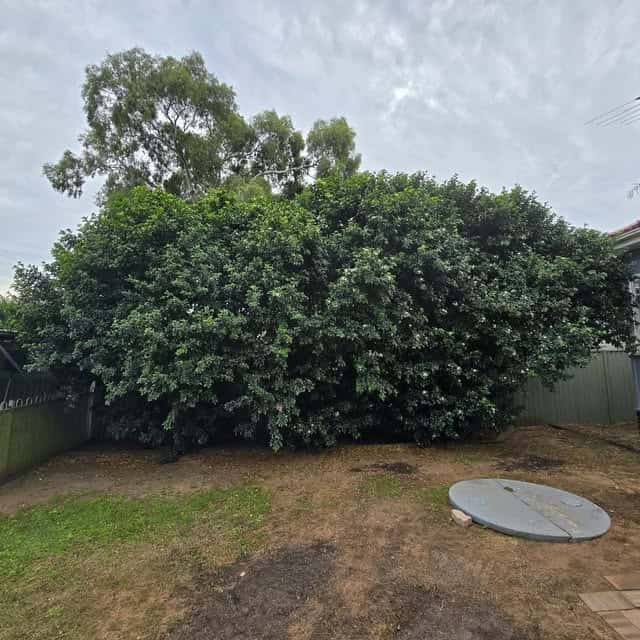
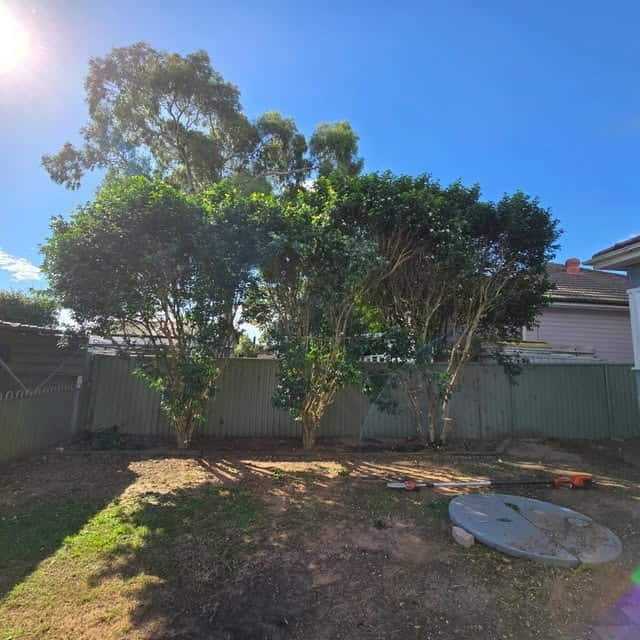
The guys came out and trimmed a large hedge that I have. It’s roughly 20m long and 2.5m high and roughly 1.5m wide. The job they did was terrific. Not only trimming it, but leveling it out. I will definitely use their services again. Fantastic job. Thanks.
read moreread less
Paul N
12/04/2024
×
Paul N
12/04/2024
The guys came out and trimmed a large hedge that I have. It’s roughly 20m long and 2.5m high and roughly 1.5m wide. The job they did was terrific. Not only trimming it, but leveling it out. I will definitely use their services again. Fantastic job. Thanks.
They did an amazing job cleaning and organising my yard. They were really friendly, gave great advice and were fair priced. Thanks dor and awesome job. Highly recommend ASET Tree Removal.
read moreread less
Angelo Iannarilli
10/12/2024
×
Angelo Iannarilli
10/12/2024
They did an amazing job cleaning and organising my yard. They were really friendly, gave great advice and were fair priced. Thanks dor and awesome job. Highly recommend ASET Tree Removal.
Mechanical excavation, done properly
Free written quote, fully insured, all NSW SafeWork operating procedures followed. The hardest bamboo jobs in Sydney — we have the machines for them.
Information in the arboriculture industry changes frequently. Linked content may change or become outdated. Please always contact us for help with your important property decisions.
1-tonne to 1.7-tonne mini excavators handle the majority of residential jobs. They fit through standard 800-900mm side gates. For larger stands or property clearances we step up to 2.5-tonne or 5-tonne machines.
Standard mini excavators are 700-900mm wide. If your gate is 800mm or wider, we can fit a 1-tonne machine through. Narrower than 800mm and we either remove a fence panel temporarily or revert to hand-only excavation.
Small contained clumping bamboo (1-2m diameter), soft soil (sand or loose loam), no boundary crossing, plant under 5 years old. Anything bigger or older benefits from machine excavation for both cost and quality reasons.
Want a Sydney bamboo specialist to look at your stand? Free on-site visit, written quote within 48 hours.
Yes, on large running bamboo stands where the rhizome network exceeds 8 metres of spread. Access has to be available — typically a wide driveway or a removable fence panel — but it can halve a 3-day job to a 1.5-day job.
Within 600mm of any fence, paving, pool, building footing or tree root zone, we switch from machine to hand tools. The machine never gets close enough to anything you’d want to protect.
A real ASET bamboo eradication programme on a Western Sydney property u2014 running bamboo, neighbour boundary, 18-month timeline. What it took to fully remove.